
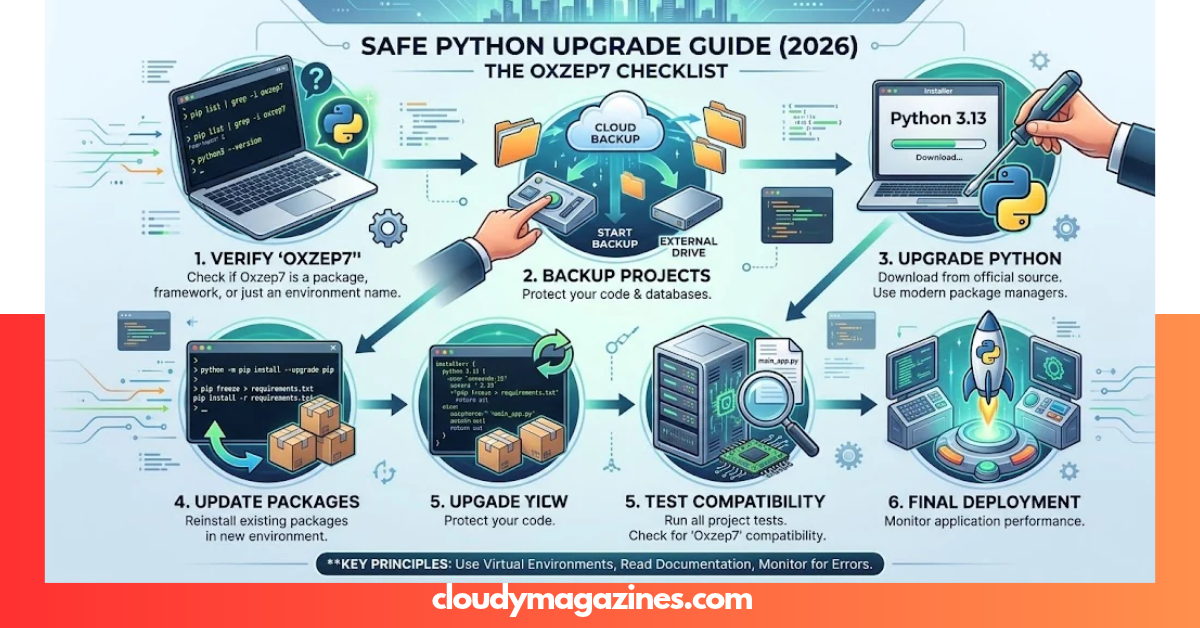
An outdated Python installation or incompatible software dependency can prevent a program from running correctly. If you are searching for a way to upgrade oxzep7 python, the first step is to identify what Oxzep7 refers to in your specific setup. Its official identity and upgrade procedure could not be verified from the available information, so this guide does not assume that it is a confirmed Python package or framework. Instead, it explains how to check your environment, update Python safely, protect existing projects, and investigate any Oxzep7-related error without risking your files.
What Is Upgrade Oxzep7 Python?
The phrase “upgrade oxzep7 python” appears to describe a search for updating Python or software associated with the name Oxzep7. However, the name alone does not establish whether it refers to a package, an application, a project identifier, or a specific error.
Python is a programming language used for automation, web development, data analysis, scripting, and many other tasks. Its installed version, third-party packages, and project configuration can all affect whether an application runs successfully.
Before attempting an upgrade, identify the software you actually have installed.
Why Should You Upgrade Oxzep7 Python Carefully?
A software upgrade can fix compatibility problems and provide access to supported features, but an unsuitable version can also break older projects.
A careful approach to upgrade oxzep7 python should address these priorities:
- Compatibility: Check which Python versions the application supports.
- Security: Obtain installers and packages from trusted, official sources.
- Project protection: Back up code and dependency information before making changes.
- Testing: Confirm that the application still works after the upgrade.
- Reversibility: Keep the previous environment available until the new setup passes testing.
Do not assume that installing the newest Python release will automatically fix an unrelated application error.
What Should You Check Before Upgrading?
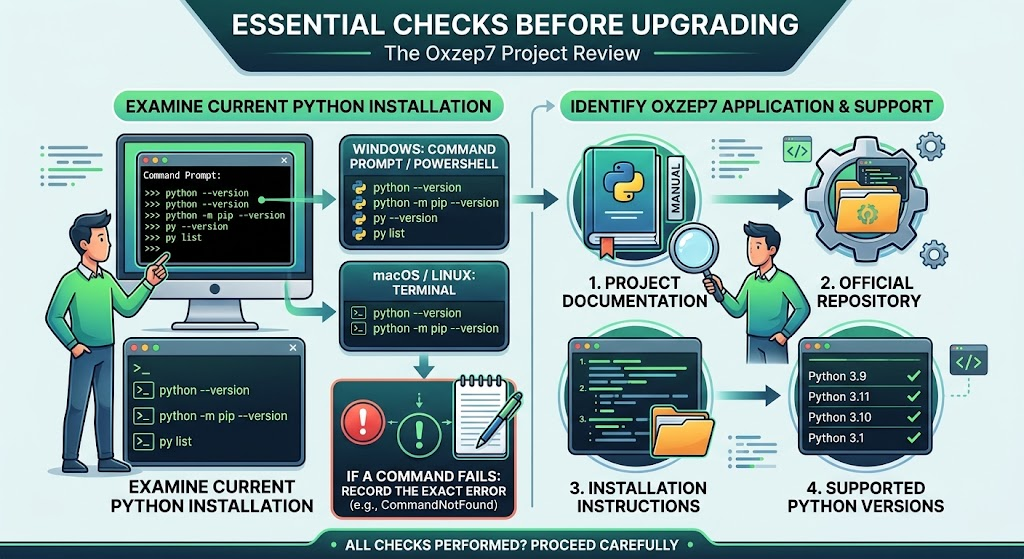
Start by examining your current Python installation. This information helps determine whether you need a Python upgrade, a package update, or a fix for a different problem.
Open Command Prompt or PowerShell on Windows, or a terminal on macOS or Linux, and run:
python –version
python -m pip –version
On Windows, you can also try:
py –version
py list
The available commands depend on how Python was installed. If a command fails, record the exact error instead of repeatedly reinstalling software.
Next, identify the application or project associated with Oxzep7. Check its official documentation, project repository, installation instructions, and supported Python versions before changing anything.
How to Upgrade Oxzep7 Python on Windows
If your goal is to upgrade the Python runtime used by a project, follow these general steps. They apply to ordinary Python installations, not to an independently verified Oxzep7 updater.
Step 1: Back Up Your Project
Save a separate copy of your source code, configuration files, and important data. If your project uses Git, check your current changes and commit or back them up before proceeding.
You should also record the packages installed in your active environment:
python -m pip freeze > requirements-backup.txt
This creates a record of installed package versions. It does not back up your source code or guarantee that every dependency will work with a different Python release.
Step 2: Download Python From an Official Source
Visit the official Python website:
https://www.python.org/downloads
For supported Windows systems, consult the official Python installation documentation to choose the appropriate installation method. The Python install manager is the recommended route in current Windows documentation.
Avoid unofficial installers that promise to repair Oxzep7 automatically without providing a verifiable publisher or documented release.
Step 3: Install a Compatible Python Version
Choose a release supported by your project. If the project requires a particular Python version, follow that requirement instead of selecting a newer release solely because it is available.
After installation, open a new terminal and check the available interpreter:
python –version
py list
If several Python versions are installed, confirm which interpreter your project actually uses. Installing a new version does not necessarily change the interpreter selected by an existing virtual environment.
Step 4: Create a Separate Virtual Environment
A virtual environment keeps project dependencies separate from those used by other applications.
From your project directory, run:
py -m venv .venv
Activate it in Windows Command Prompt:
.venv\Scripts\activate.bat
For Windows PowerShell, use:
.\.venv\Scripts\Activate.ps1
For macOS or Linux, use:
python3 -m venv .venv
source .venv/bin/activate
A new environment is generally safer than trying to force an existing environment to use a different Python version.
Step 5: Install the Required Dependencies
If your project contains a valid requirements.txt file, install its dependencies inside the activated environment:
python -m pip install -r requirements.txt
If the project uses another dependency manager, such as Poetry or uv, follow its documented installation process instead.
Do not install a package named oxzep7 merely because the search phrase contains that name. First confirm its exact package name, publisher, source repository, and installation instructions.
Step 6: Test the Application
Run the project’s documented test command or its normal startup command.
For a basic Python check, use:
python -c “print(‘Python is working’)”
This confirms that the selected interpreter can execute a simple command. It does not prove that Oxzep7 or any particular application is installed correctly.
If the project fails, save the full error message and traceback so you can investigate the actual cause.
How to Upgrade Python Packages With pip
Sometimes the Python interpreter is already correct, but an installed package is outdated. In that situation, a package update may be more appropriate than a complete Python installation upgrade.
First, check pip:
python -m pip –version
Upgrade pip in the active environment if appropriate:
python -m pip install –upgrade pip
To inspect an individual package, replace PACKAGE_NAME with its verified distribution name:
python -m pip show PACKAGE_NAME
Update it only after checking the project’s version requirements:
python -m pip install –upgrade PACKAGE_NAME
Avoid upgrading every dependency blindly. Major package updates may introduce breaking changes, and some packages do not support every Python release.
How Can You Check Oxzep7 Python Compatibility?
Compatibility checks help determine whether a failure comes from Python itself or from a dependency that no longer supports the selected runtime.
Use this checklist before and after an upgrade:
- Confirm the required Python version in the project’s official documentation.
- Check the supported versions of its essential dependencies.
- Review any release notes for breaking changes.
- Confirm that the required packages install in a clean environment.
- Run automated tests or a small, representative test of the application.
- Keep a record of errors that appear after the change.
When investigating upgrade oxzep7 python, treat the exact error as the main diagnostic clue. A missing module, a syntax error, and a failed network request require different solutions.
What Are the Main Python Upgrade Methods?
The appropriate method depends on what needs updating. Python itself, pip, and an individual application dependency are separate components.
| Upgrade method | What it updates | When to use it | Main precaution |
| Python installation upgrade | The Python interpreter | The installed runtime is outdated or unsupported | Check application compatibility |
| pip upgrade | The package installer | pip is outdated or needs a supported fix | Use the intended environment |
| Individual package upgrade | One installed dependency | A specific package needs an update | Review version constraints |
| New virtual environment | The project’s isolated runtime and dependencies | Testing a different Python version | Reinstall required dependencies |
| Application upgrade | The software itself | A verified application release provides a fix | Use the official publisher’s instructions |
| Clean reinstall | A damaged or inconsistent installation | Normal repair steps have failed | Back up files and configuration first |
This distinction matters because changing one component does not automatically update the others.
How to Troubleshoot Common Python Upgrade Errors
If your upgrade fails, identify the error before trying another installation method.
Python Command Not Found
The terminal may not be able to locate Python, or its command aliases may point to a different installation.
Try py –version on Windows. If that works, inspect your Python installation and PATH configuration rather than assuming Python is missing.
ModuleNotFoundError
This error usually means Python cannot find an imported module in the active environment.
Check which interpreter is running and whether the required package is installed there:
python -c “import sys; print(sys.executable)”
python -m pip list
Install only the missing, verified dependency using the project’s instructions.
Package Installation Fails
An installation can fail because of an unsupported Python version, unavailable compatible package builds, network restrictions, or missing system requirements.
Read the complete pip error and compare it with the package’s official installation documentation. Avoid downloading replacement files from untrusted websites.
Application Stops Working After an Upgrade
A dependency may have changed its behavior, or the application may not support the new Python release.
Check the release notes, restore the previously recorded dependency versions in a separate environment if needed, and test a compatible version combination before changing the production setup.
Permission or Access Errors
An installation may fail because the current account cannot write to the target directory.
Use a virtual environment or an installation method supported by your operating system. Avoid running every command as administrator or using elevated permissions without a clear reason.
Unknown Oxzep7 Error
If an error mentions Oxzep7, capture the full message, the command that triggered it, and the application or file where it appeared.
The name by itself is not enough to identify the cause. Do not treat it as a standard Python exception or install a purported repair tool without confirming its source.
How to Keep Your Python Setup Secure
A successful upgrade should leave your system easier to maintain, not introduce new risks.
Follow these practical safeguards:
- Download Python from the official Python website or a documented operating-system distribution.
- Install third-party packages only after verifying their names and publishers.
- Avoid commands copied from unknown websites that download and execute remote scripts.
- Keep application credentials, API keys, and passwords out of public source code.
- Use virtual environments to reduce dependency conflicts.
- Read package permissions and installation instructions before running unfamiliar code.
- Test changes before deploying them to a live application.
These practices apply whether you are maintaining a personal script, a development project, or a larger application.
What Is the Difference Between Updating Python and Updating Oxzep7?
Updating Python changes the interpreter that executes Python code. Updating a package changes a library installed in that environment, while updating an application changes the application release itself.
The distinction is important because the phrase upgrade oxzep7 python does not reveal which component needs attention.
For example, a project might require a newer Python interpreter but still depend on an older library version. Another project might run correctly on its current interpreter but need a package update to fix a bug.
Identify the component first, then make the smallest supported change that addresses the problem.
Best Practices for a Successful Python Upgrade
A repeatable upgrade process makes future maintenance easier.
- Record the current Python and dependency versions.
- Read the application’s official requirements before upgrading.
- Use a dedicated virtual environment for each project.
- Make one significant change at a time.
- Run tests after changing Python or a dependency.
- Keep backups and document any manual configuration changes.
- Remove old installations only after confirming that other projects no longer need them.
Following these steps gives you a clear path to diagnose failures and roll back changes without unnecessarily affecting unrelated projects.
Official Resources for Python Installation and Maintenance
Use primary documentation to verify installation commands and compatibility details.
- Python for Windows: https://docs.python.org/3/using/windows.html — official instructions for installing and managing Python on Windows.
- Python Downloads: https://www.python.org/downloads/ — official Python releases and installation resources.
- Python Virtual Environments: https://docs.python.org/3/library/venv.html — explains how to create and manage isolated Python environments.
- pip Installation and Upgrading: https://pip.pypa.io/en/stable/installation/ — official guidance on installing and upgrading pip.
- Python Packaging User Guide: https://packaging.python.org/en/latest/ — guidance on package installation, project dependencies, and Python packaging.
These resources explain standard Python procedures. They do not independently verify that Oxzep7 is a specific Python product or provide a confirmed Oxzep7-specific upgrade process.
Frequently Asked Questions
1. What does upgrade Oxzep7 Python mean?
The phrase appears to refer to upgrading Python or software associated with Oxzep7. Its exact meaning cannot be confirmed without the relevant application’s documentation, package listing, or error message.
2. How do I upgrade Oxzep7 Python on Windows?
First identify the software and its supported Python version. Then install a compatible Python release from an official source, create a virtual environment, install the project’s documented dependencies, and test the application.
3. Is Oxzep7 an official Python package?
Its official package identity could not be verified from the available information. Check the Python Package Index, the project’s official repository, and the publisher’s documentation before installing anything with that name.
4. Should I upgrade Python or pip first?
It depends on the problem. If the interpreter is unsupported, address the Python version first; if the interpreter is suitable but pip needs updating, upgrade pip inside the intended environment.
5. Will upgrading Python delete my projects?
Installing another Python version does not normally delete your source files, but it can affect PATH settings, dependencies, and existing environments. Back up your files and retain the old environment until the new setup passes testing.
6. How can I fix an Oxzep7 Python error?
Read the complete error message and identify the command or application that produced it. Check the interpreter version, installed dependencies, and official project requirements instead of assuming that Oxzep7 is a standard Python error.
Conclusion
A safe upgrade begins with identifying the software, checking version requirements, protecting existing files, and testing changes in an isolated environment. These steps can help resolve common Python installation and dependency problems without relying on unverified repair tools.
If you are trying to upgrade oxzep7 python, verify what Oxzep7 refers to before following a product-specific procedure. Use official Python resources for standard installation tasks, and consult the actual application’s documentation for its own upgrade requirements.
Have an Oxzep7 error message or installation guide? Check the exact package name, publisher, and command before making changes. Clear technical details are the most useful starting point for finding a reliable fix.