
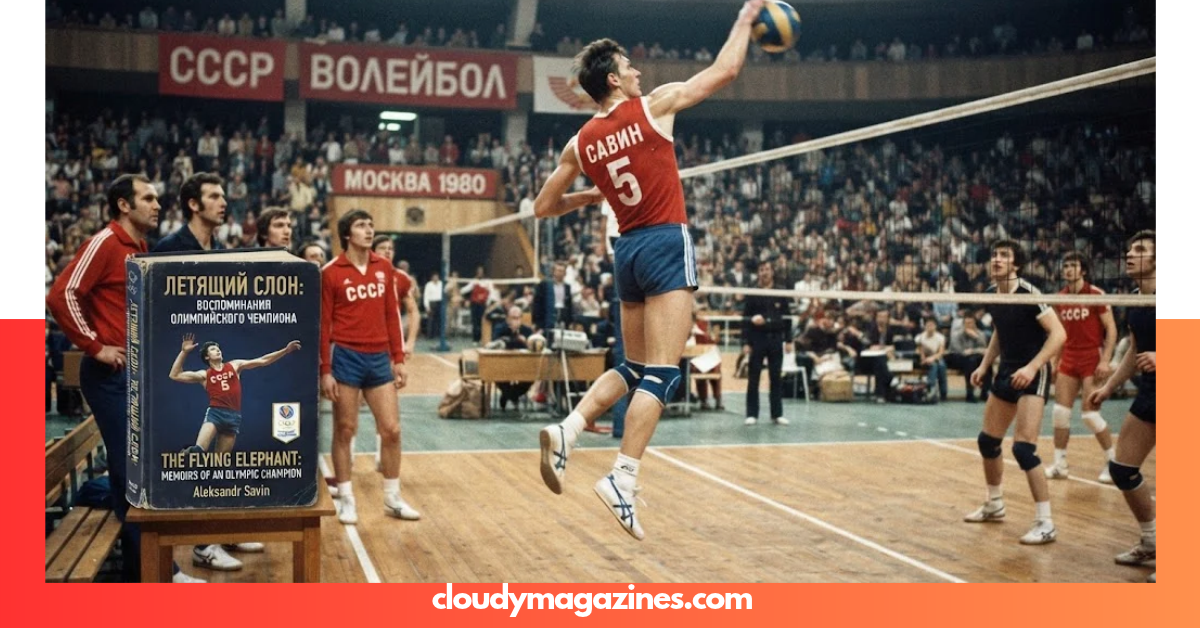
Alexander Savin’s Olympic career includes two very different moments: silver at Montreal 1976 and gold at Moscow 1980. Behind those medals was a long career in Soviet volleyball, international competition, demanding training, teammates, coaches, and years of preparation. The Flying Elephant: Memoirs of an Olympic Champion gives readers a personal route into that sporting history. It is especially useful for people who want to understand the athlete behind the Olympic results rather than simply read a list of medals.
What Is The Flying Elephant: Memoirs of an Olympic Champion?
The Flying Elephant: Memoirs of an Olympic Champion is the memoir associated with Soviet volleyball player Aleksandr Borisovich Savin, commonly written in English as Alexander Savin.
Savin represented the Soviet Union at the 1976 and 1980 Olympic Games. Olympedia records two Olympic medals for him: silver in Montreal and gold in Moscow. The International Volleyball Hall of Fame also records his Olympic achievements and inducted him in 2010.
The book is therefore more than a general sports biography. It gives readers an opportunity to look at elite volleyball through the experiences of an athlete who competed at the highest international level.
Quick Facts About The Book
| Detail | Information |
| Book title | The Flying Elephant: Memoirs of an Olympic Champion |
| Author | Alexander Savin |
| Sport | Indoor volleyball |
| Country represented | Soviet Union |
| Playing role | Middle blocker |
| Olympic Games | Montreal 1976; Moscow 1980 |
| Olympic medals | Silver in 1976; Gold in 1980 |
| Hall of Fame | International Volleyball Hall of Fame |
| Induction year | 2010 |
| Associated club | CSKA Moscow |
| English edition | Kindle edition |
| Historical setting | Soviet-era international volleyball |
The Olympic and Hall of Fame information can be checked against independent sporting records.
Who Was Alexander Savin?
To understand the flying elephant memoirs of an olympic champion alexander savin, readers first need to understand the athlete behind the book.
Alexander Savin was born on July 1, 1957, in Taganrog. Olympedia records his height as 200 cm and his Olympic affiliation with CSKA Moscow. He became one of the important players of the Soviet men’s volleyball team during the 1970s and 1980s.
His international career included much more than the Olympics. Olympedia records six European Championship gold medals and world championship gold medals in 1978 and 1982. His career therefore belongs to a period when Soviet volleyball was a major force in international competition.
The International Volleyball Hall of Fame inducted Savin in 2010 in its Male Indoor Player category. Its official biography also documents his performances at Montreal 1976 and Moscow 1980.
Why Is The Book Called The Flying Elephant?
The title naturally raises a question: Why would an elite volleyball player be associated with a flying elephant?
The image works because volleyball demands both physical presence and fast movement. Savin was around two meters tall, giving him a significant presence at the net, yet his position required jumping, blocking, timing, coordination, and quick reactions.
The contrast between a large body and athletic movement makes the phrase memorable. However, readers should separate documented facts from interpretations of the title. Available official sports records confirm Savin’s size and volleyball career, but they do not establish every popular explanation about the title as an official statement from Savin himself.
That distinction is important when researching sports memoirs. A memorable nickname can develop different explanations over time, while the athlete’s documented career remains easier to verify.
Alexander Savin’s Olympic Journey
The Olympic story gives the memoir one of its clearest structures.
Savin competed at two Olympic Games:
- Montreal 1976
- Moscow 1980
He won a silver medal at his first Olympics and returned four years later to win gold.
The International Volleyball Hall of Fame confirms that Savin played all five Soviet matches in Montreal. The Soviet team reached the final but lost 3–2 to Poland.
Four years later, Savin again played every Soviet match. The team defeated Bulgaria 3–1 in the gold-medal match and won the Olympic title in Moscow.
Olympic Record at a Glance
| Olympic Games | Team | Result |
| Montreal 1976 | Soviet Union | Silver |
| Moscow 1980 | Soviet Union | Gold |
Olympedia independently records the same two Olympic medals.
This progression is one of the strongest reasons the memoir has historical interest. The story moves from an Olympic final defeat to a later championship, while also placing those results inside Savin’s much longer career.
What Happened at the 1976 Montreal Olympics?
Montreal was Savin’s Olympic debut.
The Soviet men’s volleyball team entered the tournament as a major contender. According to the International Volleyball Hall of Fame, the team went undefeated in pool play, defeating Italy, Bulgaria, and Japan without dropping a game. The Soviet Union then defeated Cuba in the semifinal.
The final produced a different result.
Poland defeated the Soviet Union 3–2, giving Savin and his teammates the silver medal. The Hall of Fame records Savin as having played in all five matches during the tournament.
That result became an important part of his Olympic story because it was followed by another opportunity four years later.
How Did Alexander Savin Win Olympic Gold in 1980?
The 1980 Moscow Olympics brought Savin back to the Olympic stage.
The Soviet Union opened its tournament with a 3–1 victory over Czechoslovakia. The team then moved through pool play before advancing to the knockout stage.
The Hall of Fame records that Savin played in all six Soviet matches. The team defeated Romania in the semifinal and then beat Bulgaria 3–1 in the final to win Olympic gold.
The official CSKA website also lists Alexander Savin among the Soviet volleyball players who won gold at the 1980 Moscow Olympics.
From Silver to Gold
The simplest way to understand his Olympic progression is:
1976 — Silver
↓
Four years of continued international competition
↓
1980 — Gold
That sequence gives the flying elephant memoirs of an olympic champion alexander savin an important human element. Olympic success did not happen in isolation; it followed years of competition and preparation.
What Was Savin’s Role in Soviet Volleyball?
Savin played as a middle blocker, a position that demands a strong combination of height, timing, jumping ability, blocking technique, and coordination with teammates.
A middle blocker must read an opposing attack quickly and position himself at the net. The player also needs to transition between blocking and attacking without losing timing.
For Savin, those skills developed within a highly competitive Soviet volleyball system. His career was closely connected with CSKA Moscow, and official Olympic records identify CSKA Moscow as his affiliation.
The wider career record also shows that his success extended beyond Olympic volleyball.
Major Career Milestones
| Achievement | Result |
| Olympic Games | 1976, 1980 |
| Olympic medals | 1 silver, 1 gold |
| World Championships | Gold in 1978 and 1982 |
| European Championships | Six gold medals recorded by Olympedia |
| Hall of Fame | Inducted in 2010 |
| Club affiliation | CSKA Moscow |
These records show why Savin’s memoir can be read as a piece of volleyball history rather than only an Olympic story.
What Can Readers Learn About Soviet Volleyball?
One of the most interesting aspects of the flying elephant memoirs of an olympic champion alexander savin is its connection to Soviet-era volleyball.
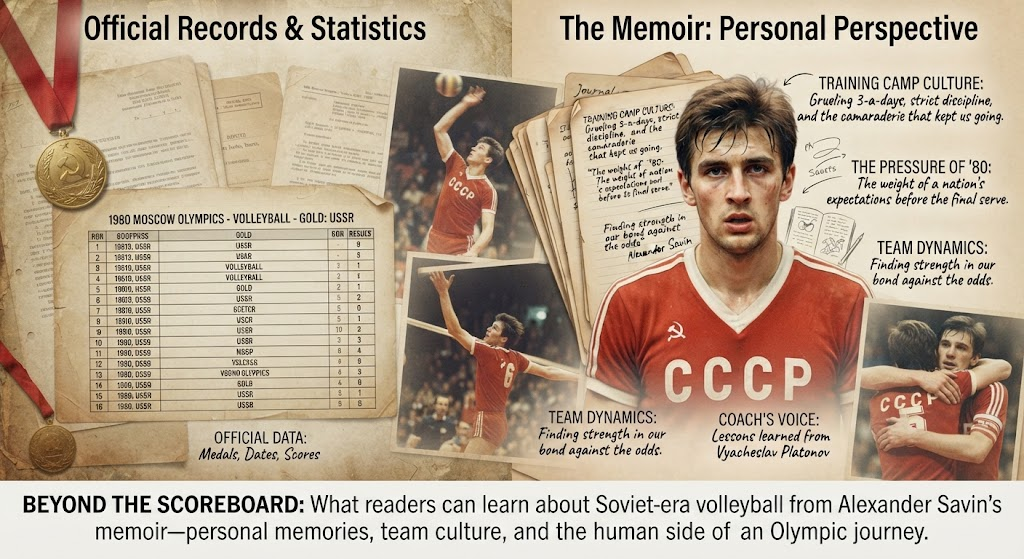
Official records tell us who won medals, where matches took place, and which teams competed. A memoir can add a different type of information: personal memories, relationships, training experiences, team culture, and the human side of competition.
That distinction matters.
A results database might tell a reader that Savin won Olympic gold in 1980. A personal memoir can potentially help readers understand what the athlete experienced around that achievement.
Readers should still treat memoirs as personal accounts. Memories are valuable historical sources, but they represent the author’s perspective rather than a complete independent history of Soviet sport.
How Does The Memoir Add to Savin’s Olympic Record?
A medal table is useful, but it has limits.
It can show:
- The year of an Olympic appearance
- The final position
- The country represented
- The medal won
- Basic competition information
It cannot fully capture:
- Relationships between teammates
- Personal memories of coaches
- Daily training experiences
- Emotional reactions to defeat
- The atmosphere around competitions
- How an athlete viewed his career years later
This is where an athlete memoir can complement official records.
The flying elephant memoirs of an olympic champion alexander savin can therefore be approached from two directions: as a personal sports story and as a historical document connected to an important generation of Soviet volleyball.
What Makes Alexander Savin’s Career Historically Interesting?
Savin competed during a period when international volleyball was highly competitive and Soviet teams had a strong record.
His Olympic results alone show a major change between his two appearances. He first finished second in Montreal and later helped the Soviet Union win gold in Moscow.
His broader international record adds more context.
Olympedia lists Savin among athletes who won six European Volleyball Championship titles. It also records world championship gold medals in 1978 and 1982.
The International Volleyball Hall of Fame’s decision to induct him in 2010 provides another independent recognition of his career.
These sources make it possible to examine the memoir without relying only on promotional descriptions.
Is The Flying Elephant Available in English?
Yes. An English-language Kindle edition has been released.
Current edition information associated with the English project identifies the title as The Flying Elephant: Memoirs of an Olympic Champion and reports an October 26, 2025 publication date. Current descriptions also report a substantial digital edition with more than 240 photographs. Because Kindle availability, pricing, and regional access can change, readers should verify the current retailer listing before purchasing.
The English edition is particularly useful for readers who cannot access the original Russian-language material.
The translation project also gives the book an additional layer of interest because it helps carry Savin’s sporting memories to an English-speaking audience.
What Is the Value of the Photographs?
Sports photographs can preserve details that statistics cannot.
Images can show:
- Team uniforms
- Olympic venues
- Teammates
- Coaches
- Training environments
- Competition settings
- Different periods of a player’s career
Current descriptions of the English edition report more than 240 photographs. These details should be checked against the live edition listing because digital-book specifications can change.
For sports historians and volleyball fans, photographs can make a memoir more useful as a visual record of an earlier era.
Who Should Read The Flying Elephant?
The book can appeal to several types of readers.
Volleyball Fans
Volleyball followers can use the memoir to explore an earlier generation of elite international players and compare that era with modern volleyball.
Olympic History Readers
Readers interested in Olympic history can follow Savin’s journey across the 1976 and 1980 Games.
Sports Historians
The book can provide personal material that complements official competition records.
Coaches and Athletes
Training, teamwork, preparation, pressure, and competitive experience are natural areas of interest for people involved in sport.
Readers Interested in Soviet Sports
Savin’s career developed during the Soviet era, making his experiences relevant to readers studying the country’s international sporting history.
The Difference Between A Memoir and a Biography
It is useful to understand the difference before reading.
A biography is normally written by someone researching another person’s life. It may use interviews, archives, newspaper reports, statistics, and other sources.
A memoir focuses on personal experiences and memories from the person who lived them.
That means the flying elephant memoirs of an olympic champion alexander savin should not be treated exactly like an academic history book.
Its value comes partly from its first-person perspective. At the same time, readers researching disputed events or broader historical questions should compare memoir claims with independent records.
That approach provides both personal detail and historical balance.
Alexander Savin’s Legacy in Volleyball
Savin’s legacy rests on several documented achievements.
He won Olympic silver in 1976 and Olympic gold in 1980. He also won major international titles with the Soviet national team and was later inducted into the International Volleyball Hall of Fame in 2010.
The official Hall of Fame biography places particular emphasis on his contribution to the Soviet team’s return to Olympic gold in 1980.
His career also remains connected to CSKA Moscow. CSKA’s own historical material identifies Savin as an Olympic champion and a two-time world champion.
Together, these records establish a strong factual foundation for understanding the athlete before exploring the memoir itself.
What Is The Main Theme of The Flying Elephant?
The central idea is not simply winning an Olympic medal.
The larger story is about the career behind the medal.
Savin’s Olympic record shows both success and disappointment. His 1976 silver medal was followed by 1980 gold, while his wider career included repeated international championships.
That makes the memoir relevant to themes such as:
- Long-term athletic development
- Teamwork
- Competitive pressure
- Training
- International sport
- Olympic history
- Personal memory
- Soviet volleyball
- Career development
- Life around elite competition
These themes make the book broader than a simple match-by-match sports record.
What Should Readers Verify Before Buying?
Book information can change, especially for digital editions.
Before buying the Kindle edition, readers should check:
- Current price
- Availability in their country
- Language
- Publication information
- Current page or print-length information
- Whether Kindle Unlimited access is offered in their region
- The current book description and preview
A live retailer page is more reliable for current commercial details than an old article or social-media post.
For historical information about Savin himself, readers can cross-check the book with the International Volleyball Hall of Fame and Olympedia.
Frequently Asked Questions
1. Who wrote The Flying Elephant: Memoirs of an Olympic Champion?
Answer: Alexander Savin is the athlete and memoirist associated with The Flying Elephant: Memoirs of an Olympic Champion. He was a Soviet volleyball player who competed at the 1976 and 1980 Olympic Games.
2. What sport did Alexander Savin play?
Answer: Alexander Savin played indoor volleyball and was a middle blocker. He represented the Soviet Union at two Olympic Games.
3. Did Alexander Savin win an Olympic gold medal?
Answer: Yes. Savin won Olympic silver at Montreal 1976 and Olympic gold at Moscow 1980 with the Soviet men’s volleyball team.
4. When did Alexander Savin win Olympic gold?
Answer: Savin won Olympic gold at the 1980 Moscow Olympics. The Soviet Union defeated Bulgaria 3–1 in the men’s volleyball final.
5. Is Alexander Savin in the International Volleyball Hall of Fame?
Answer: Yes. The International Volleyball Hall of Fame inducted Aleksandr Savin in 2010 in its Male Indoor Player category.
6. Is The Flying Elephant available in English?
Answer: Yes. An English Kindle edition of The Flying Elephant: Memoirs of an Olympic Champion has been released. Readers should check the current Amazon listing for regional price and availability because digital editions can change.
Conclusion:
The flying elephant memoirs of an olympic champion alexander savin connects a personal sports story with an important chapter in Olympic volleyball.
Alexander Savin’s documented career already provides a remarkable foundation: Olympic silver in 1976, Olympic gold in 1980, multiple international championships, and induction into the International Volleyball Hall of Fame.
The memoir adds another layer by moving beyond medal tables and competition results. It gives readers a chance to explore the athlete, teammates, coaches, competition, and sporting culture behind those achievements.