
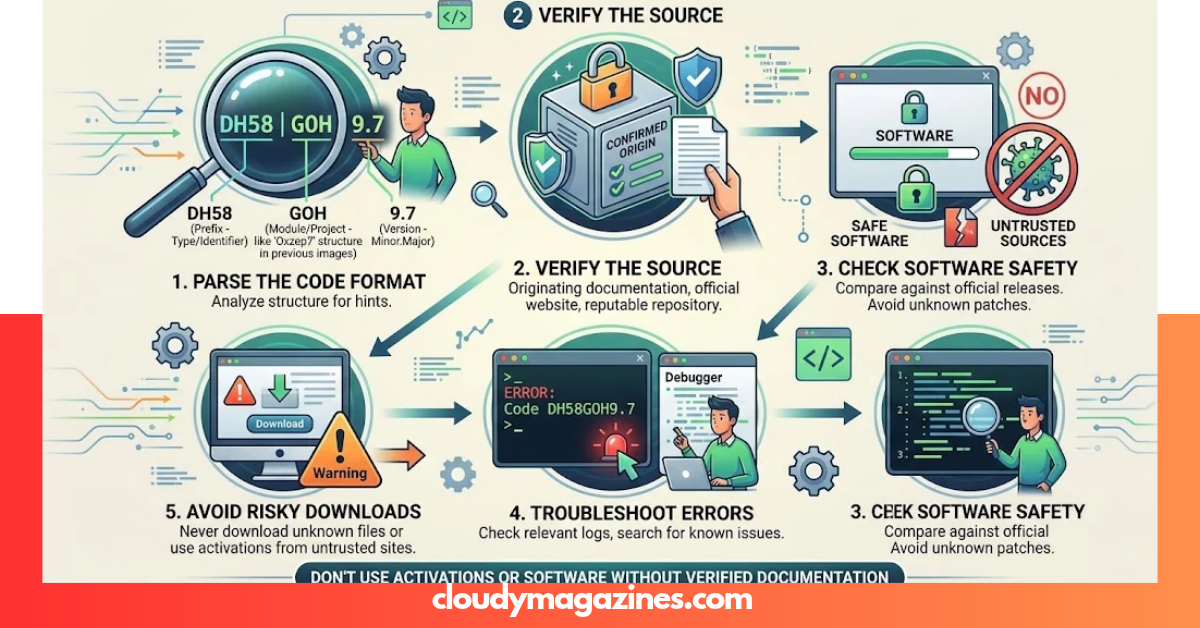
Finding an unfamiliar code on your computer or inside a software message can raise questions. Is it a version number, an error message, or a code you need to activate something? Without reliable documentation, guessing can lead to wasted time or unsafe downloads. This guide explains the dh58goh9.7 code, what its format suggests, how to investigate it, and which safety checks to complete before using any related file or application.
What Is the DH58GOH9.7 Code?
The dh58goh9.7 code is an unfamiliar alphanumeric string whose exact purpose has not been established through authoritative public documentation. Its letters, numbers, and decimal point make it resemble a technical identifier, but the name alone cannot confirm whether it belongs to a software application, system process, file, or error message.
Software developers use identifiers to label different components, packages, builds, and releases. However, there is no verified basis for assigning a specific function to this particular string.
Here are the main possibilities to investigate:
- Software identifier: A label associated with an application or component.
- Build reference: A string used to distinguish a development or testing build.
- Version-style label: A technical name that resembles a software version.
- Diagnostic reference: A value displayed in a log or troubleshooting message.
- Unknown code: A string whose purpose cannot be identified without more context.
These are possibilities, not confirmed explanations. The location where the code appears is the best starting point for identifying it.
Why Is the DH58GOH9.7 Code Getting Attention?
Unfamiliar technical names naturally attract curiosity, especially when people encounter them while searching for software updates or investigating computer problems.
The dh58goh9.7 code also has a format that looks technical. The combination of letters and numbers resembles identifiers commonly used in development environments, while the decimal suffix may remind readers of familiar software releases.
However, an unusual name does not automatically represent a new application, a security threat, or an important system update.
When researching an unfamiliar identifier, focus on verifiable details rather than online claims. Look for an official developer, technical documentation, a release history, and a clear explanation of what the identifier represents.
If those details are unavailable, treat the code as unidentified until further evidence becomes available.
What Does Each Part of DH58GOH9.7 Mean?
The structure of the dh58goh9.7 code can be examined without assuming that its individual characters have official meanings.
| Code component | Possible interpretation | What can be confirmed? |
| DH | Project or component label | No official meaning established |
| 58 | Internal number or identifier | No documented interpretation |
| GOH9 | Additional alphanumeric identifier | Exact purpose unknown |
| .7 | Possible version-style suffix | No verified version meaning |
| Full string | Technical identifier or another type of code | Its actual purpose remains unconfirmed |
This table describes possible naming patterns, not a verified decoding of the string.
For comparison, the official Semantic Versioning specification defines a standard version number using three numeric components: major, minor, and patch. The presence of a decimal point in an unfamiliar string does not establish that it follows this standard.
The key takeaway is simple: the code’s appearance alone cannot establish its meaning.
Is DH58GOH9.7 a Software Version?
The dh58goh9.7 code may look like a software version, but there is insufficient evidence to confirm that interpretation.
Software versions identify releases of a particular product. Developers may use formats such as 1.2.3, 2.4.0, or other documented naming systems. These numbers become meaningful when they are linked to a known application and its release history.
An unfamiliar string can also contain a project identifier, build reference, or internal label. Therefore, it would be inaccurate to describe DH58GOH9.7 as a specific release without documentation from its developer.
To verify a suspected version number, check the application’s official website, release notes, update history, or built-in About section.
Where Might You Find the DH58GOH9.7 Code?
The context in which you discover the dh58goh9.7 code can provide useful clues about its purpose.
For example, different locations suggest different investigation methods.
- Application folder: Check which program owns the folder and whether its publisher is identifiable.
- Downloads folder: Review the original download source, file extension, and publisher information.
- Error message: Read the complete message and note the application that produced it.
- System log: Examine nearby entries and identify the process or component that generated them.
- Software update: Confirm the update through the application’s official update mechanism.
- Website: Check whether the page identifies a developer and links to genuine technical documentation.
- Mobile device: Review the app’s name, installation source, permissions, and available publisher information.
Do not assume that every appearance of the same string refers to the same program. A code copied into a blog post may have a completely different context from a value recorded by a computer.
How to Check Whether DH58GOH9.7 Is Safe
The name itself cannot determine whether an associated file is safe. You need to examine the file, its source, and its behavior.
Follow these practical checks before opening or installing anything associated with the dh58goh9.7 code.
1. Identify the Original Source
Ask where the file came from. An official developer website, a trusted software store, and an unfamiliar download page offer different levels of confidence.
If the source cannot be verified, avoid running the file until you can establish its origin.
2. Check the Publisher
On Windows, right-click the file, select Properties, and look for the Digital Signatures tab when available.
Check whether the signer matches the developer you expect. Microsoft explains how digital signatures help verify a publisher and whether signed content has changed since signing. A valid signature is useful evidence, but it does not guarantee that a file is harmless.
See Microsoft’s digital signature documentation for details.
3. Scan the File
Windows users can right-click a suspicious file and select Scan with Microsoft Defender. On some Windows 11 systems, you may need to choose Show more options first.
You can also run a broader scan through Windows Security if you suspect a problem. Microsoft’s Windows Security guidance explains these options.
4. Review the Permissions
Be cautious if an unfamiliar application requests administrator access, access to sensitive files, or permissions that do not match its stated purpose.
An unexplained request for extensive permissions is a reason to investigate further before proceeding.
5. Avoid Unverified Downloads
Do not download an application simply because a website claims it is the official software associated with the code.
First establish the developer, intended purpose, supported operating system, and official download location. If these details cannot be verified, do not install it.
Is the DH58GOH9.7 Code a Virus or Malware?
There is no reliable evidence establishing the dh58goh9.7 code itself as a virus or malware. There is also insufficient evidence to declare every file associated with that name safe.
A code is not the same thing as an executable file. Malware risk depends on the actual file, its origin, its behavior, and the security findings associated with it.
Watch for warning signs such as:
- Unexpected pop-ups or browser redirects.
- Unknown programs starting automatically.
- Unexplained changes to browser settings.
- Security warnings during installation.
- Requests for passwords or sensitive account details without a clear reason.
- Unusual system activity after opening an unknown file.
These signs do not prove that the code is responsible, but they justify checking the device.
If you suspect an infection, disconnect from the internet if necessary to limit further suspicious activity, run a reputable security scan, and avoid entering sensitive credentials on a potentially compromised device.
How to Troubleshoot a DH58GOH9.7 Error
If the dh58goh9.7 code appears in an error message, start by identifying the application that produced it. The code alone does not establish the cause of the problem.
Use this troubleshooting sequence:
- Record the full error message. Include the text immediately before and after the code.
- Identify the affected application. Note its name, version, and publisher.
- Restart the application. A temporary issue may disappear after a normal restart.
- Check for official updates. Install updates only through a verified source.
- Review relevant logs. Look for related errors around the same time.
- Run a security scan. Do this if the message appeared after an unexpected download or installation.
- Contact official support. Provide the full message and relevant diagnostic information.
Avoid deleting system files or changing advanced settings based solely on the identifier. Such actions can create additional problems without addressing the original cause.
How to Investigate the Code on Windows
Windows users can gather more information without immediately running an unfamiliar program.
First, locate the file or application associated with the dh58goh9.7 code. Check its properties, publisher, file location, creation date, and digital signature when available.
Next, open Windows Security and scan the relevant file. If the code appears inside an application’s log, check the application documentation before changing or removing anything.
Use this checklist:
| Check | What to look for | Recommended action |
| File name | Does it match the application’s documented files? | Investigate unfamiliar names |
| File location | Is it inside a recognized application folder? | Verify which program owns it |
| Publisher | Is the developer identifiable? | Confirm the publisher |
| Digital signature | Is a valid signature present? | Review the signer and trust status |
| Security scan | Does the scanner report a threat? | Follow the security tool’s guidance |
| Error log | Is there a complete message or related event? | Use the context to troubleshoot |
| Official documentation | Does the developer explain the identifier? | Follow verified instructions |
A familiar location or clean scan is not absolute proof of safety. Consider all available evidence before deciding what to do.
How to Investigate the Code on Android
If the dh58goh9.7 code appears on an Android phone, first determine whether it is part of an app name, an error message, a downloaded file, or a notification.
Open your device settings and review the relevant application’s details. Check its installation source, developer information, permissions, and available security warnings.
For unfamiliar APK files, avoid installing them until you have verified their source. An application distributed outside a trusted store deserves particular scrutiny, especially if it requests access to messages, accessibility services, contacts, or other sensitive information without a clear reason.
If an existing app displays the code, contact its official support team rather than downloading a replacement from an unrelated website.
Should You Download or Install DH58GOH9.7?
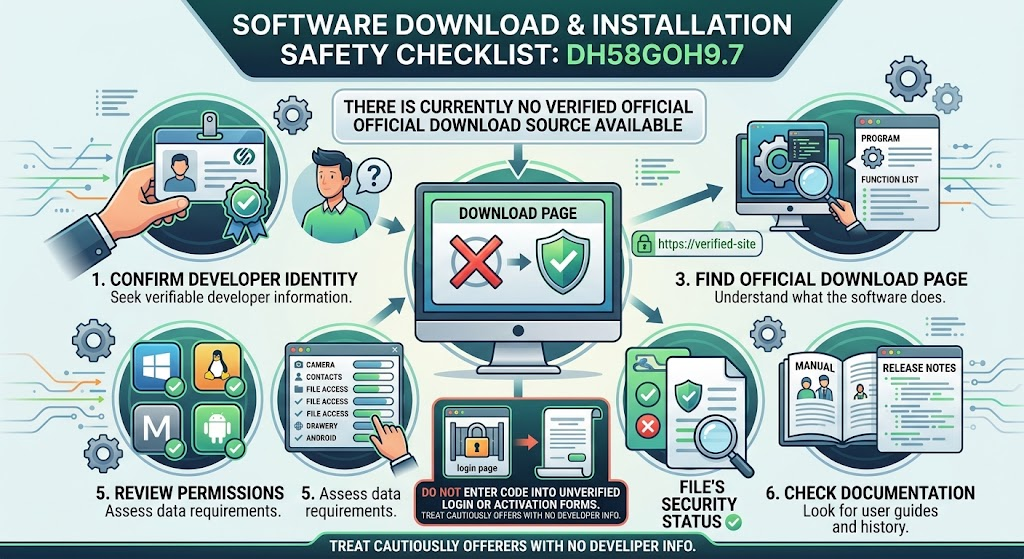
There is currently no verified official download source that can confidently be recommended for DH58GOH9.7 as a recognized public software product.
That does not prove that no private, internal, or limited-use project uses the identifier. It means there is not enough verified information to recommend a particular download.
Before installing related software, confirm these details:
- The developer’s identity.
- The application’s actual purpose.
- The official download page.
- The supported operating system.
- The permissions required.
- The availability of documentation or release notes.
- The file’s security status.
If a website promises special features, free access, or a necessary update but provides no verifiable developer information, treat the offer cautiously.
Important: Do not enter the code into a login page or activation form unless the legitimate service that issued it explains what it is for.
Common Mistakes to Avoid When Researching DH58GOH9.7
A careful investigation can prevent unnecessary downloads, accidental file deletion, and wasted troubleshooting time.
Avoid these common mistakes:
- Assuming the code is an application: A technical-looking string may identify something else.
- Treating .7 as a confirmed version: The suffix does not prove a specific release.
- Trusting unsupported claims: A blog post is not a substitute for official technical documentation.
- Calling it malware without evidence: The name alone cannot establish malicious behavior.
- Installing a random file: An unfamiliar download should be verified first.
- Deleting files immediately: Removing a legitimate component can break an application.
- Ignoring the original context: The complete error message or file location may be more informative than the code.
The best approach is to collect evidence, verify the source, and take action only when the available information supports it.
What Information Can Confirm the Code’s Real Meaning?
To identify the dh58goh9.7 code accurately, look for evidence connecting it to a specific application, device, or technical system.
The most useful information includes the exact message in which it appears, the name of the associated program, the file extension, the publisher, and the original source.
Official documentation is especially valuable because it can explain whether a string is a version, error identifier, package name, or internal reference.
If you cannot find an authoritative explanation, state that the meaning remains unverified. This is more useful than inventing technical details that could mislead readers.
Information that helps with verification
| Evidence | Why it matters |
| Full error message | Helps identify the system reporting the code |
| Application name | Connects the string to a possible product |
| File extension | Helps distinguish an executable from a text or configuration file |
| File location | Shows where the string or associated file appears |
| Publisher details | Helps establish who created or distributed the software |
| Official documentation | May confirm the code’s intended meaning |
| Security scan results | Provides evidence about a specific file, not just its name |
Share only non-sensitive diagnostic details when requesting help. Never publish passwords, private access tokens, personal account information, or confidential company files.
Frequently Asked Questions
1. What is the dh58goh9.7 code?
The dh58goh9.7 code is an unidentified alphanumeric string that resembles a technical identifier. Its exact purpose has not been confirmed through authoritative public documentation.
2. Is DH58GOH9.7 a real software program?
There is insufficient authoritative evidence to identify it as a recognized standalone software product. Its actual role may become clearer if you know which application, file, or system displays it.
3. Is the dh58goh9.7 code safe?
The code itself cannot be classified as safe or dangerous based on its name. Verify the source and examine any associated file with reputable security tools before running it.
4. Does DH58GOH9.7 mean software version 9.7?
Not necessarily. The final portion resembles version-style numbering, but no verified documentation establishes that it represents a particular software release.
5. How do I fix a dh58goh9.7 error?
Record the full error message, identify the application, check official documentation, and install verified updates when appropriate. The correct fix depends on the system that generated the message.
6. Where can I download DH58GOH9.7?
No verified official download source can currently be recommended for it as a recognized public software product. Avoid downloading files from unrelated websites until the publisher and purpose have been confirmed.
Conclusion
The dh58goh9.7 code remains an unidentified technical string rather than a confirmed public software product. Its format may resemble a build identifier, version label, diagnostic reference, or another type of code, but its exact meaning requires evidence from the system that produced it.
The safest next step is to check where the string appears, identify the associated application or file, and look for documentation from a verifiable source. Avoid unsupported claims, unverified downloads, and unnecessary changes to your device.
Have you encountered this code in a Windows error, an Android app, a downloaded file, or a website? Identifying that context is the most useful way to narrow down its meaning and determine the right next step.