
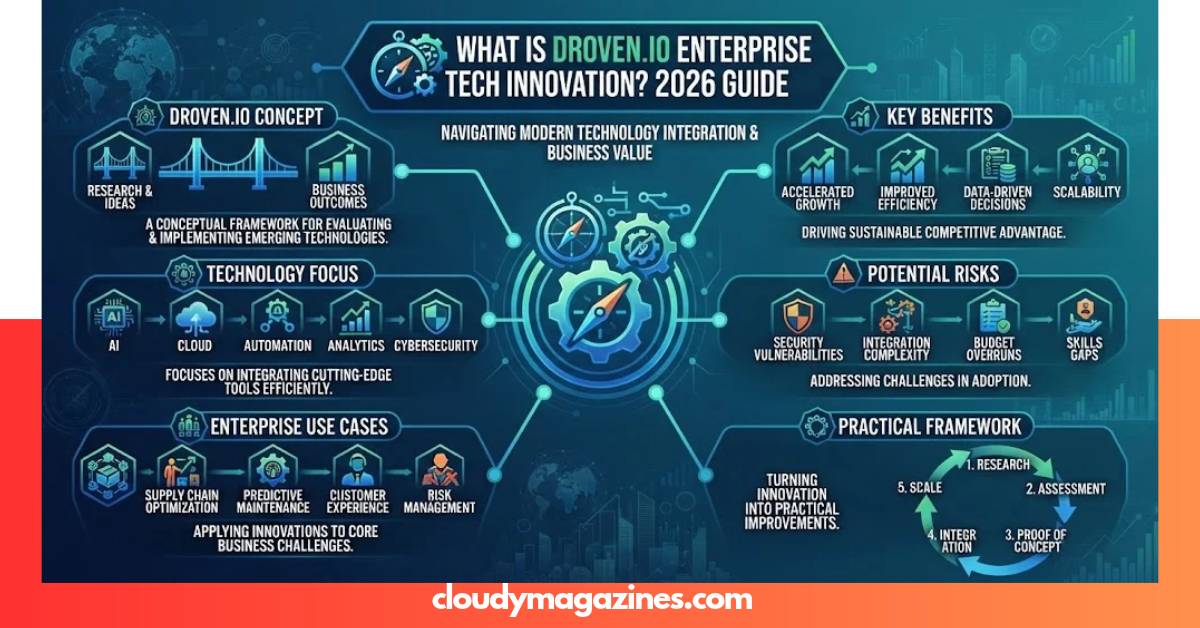
Businesses face a difficult technology problem: new AI, cloud, automation, analytics, and cybersecurity tools arrive faster than teams can evaluate them. Choosing the wrong system can waste budget, create integration problems, or introduce security risks. Droven.io enterprise tech innovation provides a useful research topic for understanding how modern technology connects with business operations, while primary sources such as NIST and Google Cloud provide authoritative guidance for evaluating implementation, security, and governance.
This guide explains what Droven.io is, what the enterprise technology concept means, where AI and automation fit, and how organizations can turn technology research into practical business improvements.
What Is Droven.io Enterprise Tech Innovation?
Droven.io enterprise tech innovation refers to the intersection of Droven.io’s technology-focused publishing and the broader field of enterprise technology innovation.
The public Droven.io website presents itself as an editorial platform covering artificial intelligence, emerging technology, startups, software development, digital transformation, and the future of work. Its visible topic structure includes areas such as AI News, AI Tools, Machine Learning, Generative AI, Robotics, Startups, Development, and Future Tech.
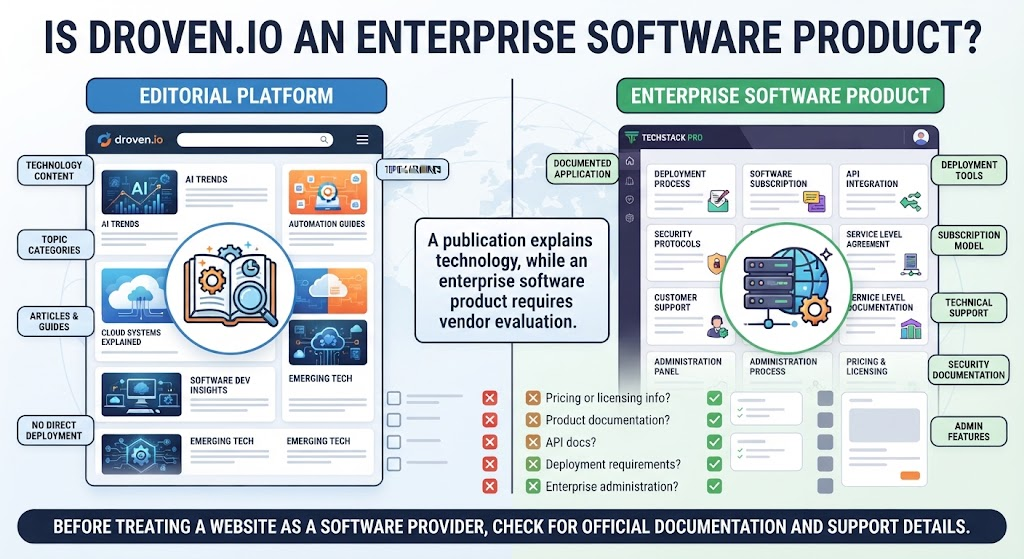
The phrase should not automatically be interpreted as the name of a specific enterprise software product. The public site presents Droven.io primarily as an information resource rather than a conventional enterprise SaaS platform with a documented deployment environment, pricing structure, or enterprise administration console.
Quick Answer
Droven.io enterprise tech innovation is best understood as a technology research topic connecting Droven.io’s coverage of modern technology with the practical use of AI, automation, cloud computing, analytics, cybersecurity, and software innovation inside organizations.
Businesses can use technology publications for early research, but they should validate important technical, security, compliance, pricing, and performance claims against primary vendor documentation and recognized standards.
What Does Enterprise Tech Innovation Actually Mean?
Enterprise technology innovation means applying technology to solve meaningful organizational problems.
It can involve replacing manual processes, improving customer service, analyzing large datasets, modernizing infrastructure, strengthening cybersecurity, or creating new digital products.
The important point is that innovation starts with a business problem rather than a technology trend.
For example, a company might discover that employees spend thousands of hours processing invoices manually. Instead of adopting AI simply because it is popular, the company can investigate document processing, workflow automation, data extraction, human review, and system integration.
A useful enterprise innovation project normally answers five questions:
- What problem needs improvement?
- Which technology can address it?
- What data does the technology require?
- What risks could the implementation create?
- How will the organization measure the result?
This approach keeps technology connected to measurable business needs.
How Does Droven.io Enterprise Tech Innovation Connect With AI?
Artificial intelligence is one of the most important areas in modern enterprise technology.
Droven.io enterprise tech innovation connects naturally with AI because organizations increasingly explore machine learning, generative AI, computer vision, intelligent automation, and AI-assisted software development.
Common enterprise AI applications include:
- Customer-support assistants
- Document classification
- Data extraction
- Predictive forecasting
- Fraud detection
- Recommendation systems
- Knowledge-search systems
- Software development assistance
- Quality inspection
- Marketing analysis
- Business intelligence
- Workflow automation
However, successful AI adoption requires more than selecting a model.
Organizations need reliable data, clear ownership, security controls, evaluation methods, monitoring, and human oversight. NIST’s AI Risk Management Framework provides voluntary guidance for organizations designing, developing, deploying, or using AI systems and focuses on managing risks while supporting trustworthy AI practices.
Why AI Governance Matters
An enterprise AI system can influence important decisions, process sensitive information, or interact directly with customers.
NIST identifies trustworthiness characteristics including validity and reliability, safety, security and resilience, accountability and transparency, explainability and interpretability, privacy enhancement, and fairness with harmful bias managed.
That makes governance part of technology design rather than an afterthought.
What Technologies Fit Into Enterprise Innovation?
Enterprise innovation involves several connected technology categories.
| Technology | Enterprise role | Common applications | Key consideration |
| Artificial intelligence | Intelligent analysis and decision support | AI assistants, forecasting, classification | Accuracy and governance |
| Generative AI | Content and knowledge workflows | Summaries, drafting, search, coding | Data protection and evaluation |
| Cloud computing | Scalable infrastructure | Applications, storage, analytics | Security and cost control |
| Automation | Reduces repetitive work | RPA, workflow automation | Process quality |
| Data analytics | Converts data into insights | Dashboards, forecasting, reporting | Data quality |
| Cybersecurity | Protects systems and information | Identity, monitoring, threat detection | Risk management |
| Machine learning | Predictive and classification tasks | Recommendations, detection, forecasting | Model performance |
| Robotics | Physical task automation | Manufacturing, warehouses, inspection | Safety and integration |
| APIs | Connects applications | Data exchange and workflow integration | Access control |
| DevOps | Improves software delivery | Testing, deployment, monitoring | Reliability |
Cloud architecture also plays an important role. Google’s Well-Architected Framework emphasizes secure, efficient, resilient, high-performing, cost-effective, and sustainable cloud environments.
Is Droven.io an Enterprise Software Product?
The public Droven.io website currently presents itself as a technology and AI editorial platform rather than a conventional enterprise software product. Its homepage emphasizes technology content and topic categories rather than a documented enterprise application, deployment process, or software subscription model.
That distinction matters for readers searching for droven.io enterprise tech innovation.
Reading about enterprise technology and purchasing an enterprise technology product are two different activities. A publication can help explain AI, automation, cloud systems, software development, and emerging technologies, while an actual enterprise deployment requires separate vendor evaluation.
Before treating any website as a software provider, check for:
- Official product documentation
- Pricing or licensing information
- Product demonstrations
- API documentation
- Security documentation
- Integration guides
- Service-level information
- Customer support details
- Deployment requirements
- Enterprise administration features
If those details are not publicly documented, avoid assuming that an editorial website provides the underlying technology it discusses.
How Can Businesses Use Droven.io for Technology Research?
Droven.io enterprise tech innovation can be useful as a starting point for technology discovery.
A business leader may encounter an unfamiliar technology term and need a simple explanation before speaking with engineers, vendors, consultants, or security teams.
A practical research process looks like this:
1. Define the business problem
Write down the current problem in measurable terms.
Example:
Customer-service employees spend four hours each day searching internal documents for answers.
2. Research technology categories
Explore possible solutions such as enterprise search, retrieval-augmented generation, knowledge management, or workflow automation.
3. Check primary documentation
Move from general explanations to official documentation from technology providers and recognized standards organizations.
4. Identify constraints
Consider:
- Budget
- Data sensitivity
- Existing software
- Compliance requirements
- Employee skills
- Infrastructure
- Integration requirements
5. Run a controlled pilot
Test the solution with a limited group before expanding it across the organization.
6. Measure results
Compare the new process against the original baseline.
Useful metrics can include:
- Processing time
- Error rate
- Cost per transaction
- Customer response time
- Employee productivity
- System availability
- Security incidents
- User satisfaction
This process turns technology research into a measurable business project.
What Are the Main Benefits of Enterprise Technology Innovation?
The benefits depend on the technology and business problem, but several areas appear repeatedly across enterprise projects.
Faster workflows
Automation can reduce repetitive manual steps and allow employees to focus on higher-value tasks.
Better access to information
Search, analytics, and AI systems can help employees find relevant information faster when organizations structure their data properly.
Improved customer experiences
Digital systems can support faster responses, personalized services, and more consistent customer interactions.
Scalable operations
Cloud infrastructure can help organizations expand computing resources as workloads change. Google’s cloud architecture guidance specifically addresses reliability, performance, security, cost, and sustainability as architectural considerations.
Stronger decision support
Analytics and machine learning can help teams identify patterns in large datasets that are difficult to review manually.
Better software delivery
Modern development practices can automate testing, deployment, monitoring, and other repetitive engineering activities.
The strongest results usually come when organizations connect technology directly to measurable operational goals.
What Are the Risks to Consider?
Technology innovation creates opportunities, but every implementation also introduces risks.
A company should evaluate those risks before deployment rather than after a problem occurs.
Data privacy
AI and analytics systems may process customer, employee, financial, or operational information.
Teams should understand what information enters a system, where it is stored, who can access it, and how long it remains available.
Cybersecurity
New applications create additional systems, identities, APIs, and connections that attackers may target.
Integration problems
A new application may fail to deliver value if it cannot communicate reliably with existing systems.
Incorrect AI outputs
Generative AI can produce inaccurate or unsupported responses. Organizations should test outputs against defined quality requirements before using AI in important workflows.
Vendor dependency
Organizations should understand how difficult it would be to move data or workflows to another provider.
Cost growth
A low-cost pilot can become expensive when usage expands. Teams should calculate licensing, infrastructure, integration, maintenance, training, and support costs.
NIST’s AI RMF is designed to help organizations manage AI risks across design, development, deployment, use, and evaluation rather than treating risk as a single final-stage check.
How Should Companies Evaluate an Innovation Project?
A structured evaluation makes technology decisions clearer.
| Evaluation area | Questions to ask | Evidence to collect |
| Business value | What problem will this solve? | Baseline metrics |
| Technology | Does it meet technical requirements? | Product documentation |
| Security | How is information protected? | Security documentation |
| Privacy | What data does it process? | Data-processing details |
| Integration | Can it connect to existing systems? | API and integration documentation |
| Scalability | Can it handle future demand? | Capacity information |
| Cost | What is the full cost? | Licensing and infrastructure estimates |
| Reliability | What happens when the system fails? | Availability and recovery plans |
| Governance | Who owns the system? | Policies and responsibilities |
| User adoption | Will employees use it correctly? | Training and feedback |
| Measurement | How will success be tracked? | KPIs and dashboards |
This framework also helps separate exciting demonstrations from solutions that can operate reliably at enterprise scale.
What Role Does Cybersecurity Play?
Cybersecurity should remain part of the project from the beginning.
A technology initiative may involve cloud infrastructure, APIs, employee accounts, databases, third-party services, AI models, and sensitive information. Each component can introduce security requirements.
Organizations should consider:
- Identity and access management
- Multi-factor authentication
- Least-privilege access
- Encryption
- Network security
- Logging and monitoring
- Vulnerability management
- Incident response
- Backup and recovery
- Third-party risk
- Secure software development
Security teams should participate before deployment rather than receiving a finished system for approval.
For AI projects, governance should also cover model access, data sources, evaluation procedures, monitoring, human oversight, and incident handling. NIST’s AI RMF and companion Playbook provide a structured starting point through the functions Govern, Map, Measure, and Manage.
How Does Cloud Computing Support Innovation?
Cloud computing gives organizations access to scalable infrastructure without requiring every workload to run on traditional on-premises systems.
Businesses can use cloud platforms for:
- Application hosting
- Data storage
- Machine learning
- Analytics
- Disaster recovery
- Collaboration
- Development environments
- Automated deployments
- Content delivery
However, moving to the cloud does not automatically improve an organization’s technology strategy.
Teams still need to design appropriate architecture, control costs, protect data, manage identities, and monitor system performance.
Google’s Well-Architected Framework highlights several dimensions organizations should consider when designing and operating cloud workloads, including security, reliability, operational excellence, performance, cost, and sustainability.
What Does a Practical Innovation Roadmap Look Like?
A company can organize its technology program into clear stages.
Phase 1: Discovery
Identify business problems and establish measurable baselines.
Phase 2: Research
Study relevant technology categories and compare possible approaches.
Phase 3: Risk assessment
Review security, privacy, compliance, technical, financial, and operational risks.
Phase 4: Pilot
Deploy a limited proof of concept with defined success criteria.
Phase 5: Evaluation
Measure performance against the original baseline.
Phase 6: Improvement
Fix technical and operational problems discovered during the pilot.
Phase 7: Controlled expansion
Increase adoption gradually instead of deploying everywhere at once.
Phase 8: Continuous monitoring
Track performance, cost, security, user adoption, and business outcomes.
This staged approach helps organizations learn before committing significant resources.
Droven.io Enterprise Tech Innovation: Research vs. Implementation
One of the most important distinctions is the difference between technology information and technology implementation.
Droven.io enterprise tech innovation can be approached as an information and research topic. The actual implementation of an enterprise solution requires additional evidence from technology vendors, internal IT teams, security professionals, legal teams, architects, and business owners.
| Research stage | Implementation stage |
| Learn what a technology does | Configure the technology |
| Identify possible use cases | Build the selected workflow |
| Compare technology categories | Integrate business systems |
| Understand terminology | Configure security |
| Explore emerging trends | Train employees |
| Research possible benefits | Measure business outcomes |
| Identify potential risks | Monitor and manage risks |
This distinction helps readers avoid treating educational content as a substitute for technical due diligence.
How Can Companies Build Trustworthy AI Systems?
Trustworthy AI requires attention throughout the AI lifecycle.
NIST describes its AI RMF as a voluntary resource designed to help organizations incorporate trustworthiness considerations into the design, development, use, and evaluation of AI systems.
Organizations can strengthen AI governance by creating:
- Clear AI ownership
- Approved use cases
- Data governance policies
- Model evaluation procedures
- Human-review requirements
- Security controls
- Privacy safeguards
- Monitoring processes
- Incident-response procedures
- Documentation requirements
- Employee training
AI governance should match the risk of the application.
An internal tool that summarizes low-risk documents may require a different control environment from an AI system that influences financial, employment, healthcare, or other high-impact decisions.
Who Can Benefit From This Technology Research?
Droven.io enterprise tech innovation can interest several groups.
Business leaders
Executives can use technology research to understand emerging categories before approving investments.
IT teams
Technology professionals can use introductory material to identify areas that require deeper technical investigation.
Developers
Developers can explore emerging software technologies, AI frameworks, automation approaches, and development practices.
Startup founders
Founders can research enterprise technology trends while developing products and services.
Students
Students can build foundational knowledge of AI, cloud computing, software development, robotics, and emerging technology.
Technology researchers
Researchers can use editorial content as a starting point before moving to technical papers, official documentation, standards, and product specifications.
For high-stakes decisions, primary documentation should remain the final verification layer.
A Simple Enterprise Innovation Checklist
Before approving a technology project, ask:
- Is the business problem clearly defined?
- Do we have a measurable baseline?
- Is the proposed technology appropriate for the problem?
- Have we reviewed official technical documentation?
- Have we assessed security requirements?
- Have we assessed privacy requirements?
- Do we understand integration requirements?
- Do we know the total expected cost?
- Have we defined ownership?
- Have we created success metrics?
- Have employees received appropriate training?
- Have we planned human oversight?
- Have we tested the system before scaling?
- Do we have monitoring and incident procedures?
A checklist like this turns a broad technology discussion into a practical decision process.
Frequently Asked Questions
What is droven.io enterprise tech innovation?
Answer: Droven.io enterprise tech innovation describes the relationship between Droven.io’s technology-focused editorial coverage and the broader practice of applying AI, cloud computing, automation, analytics, cybersecurity, and software innovation to business operations.
Is Droven.io an enterprise software company?
Answer: The public Droven.io website presents itself as an editorial technology and AI platform. Its public homepage focuses on technology content and categories rather than documenting a conventional enterprise software product.
What topics does Droven.io cover?
Answer: Droven.io publicly lists areas including AI News, AI Tools, Machine Learning, Generative AI, Robotics, Startups, Development, and Future Tech. It also highlights topics such as OpenAI, Gemini, ChatGPT, automation, deep learning, neural networks, AI ethics, and computer vision.
How can businesses use Droven.io enterprise tech innovation research?
Answer: Businesses can use the topic for early-stage technology research, education, and idea discovery. Before purchasing or deploying technology, teams should validate important claims through official documentation, security evidence, technical testing, and internal review.
Why is AI governance important for enterprise innovation?
Answer: AI systems can create risks involving accuracy, privacy, security, transparency, accountability, and bias. NIST’s AI RMF provides voluntary guidance for identifying and managing these risks throughout the AI lifecycle.
What should a company check before adopting new technology?
Answer: Start with the business problem, then evaluate technical fit, security, privacy, integration, scalability, cost, governance, employee adoption, and measurable outcomes. A controlled pilot can reveal problems before a large deployment.
Conclusion
Droven.io enterprise tech innovation is best approached as a technology research topic rather than automatically treating the phrase as the name of a specific enterprise software product. Droven.io’s public website presents an editorial platform focused on AI, emerging technology, software development, startups, robotics, and future technology.
The real value comes from connecting technology knowledge with disciplined business evaluation. Companies can research AI, cloud computing, automation, analytics, cybersecurity, and other emerging technologies, then validate those ideas through primary documentation, controlled testing, security reviews, governance, and measurable business goals.