Choosing between two things can become repetitive when you have to name both items again. The former and the latter give writers a short way to refer back to two previously mentioned things.
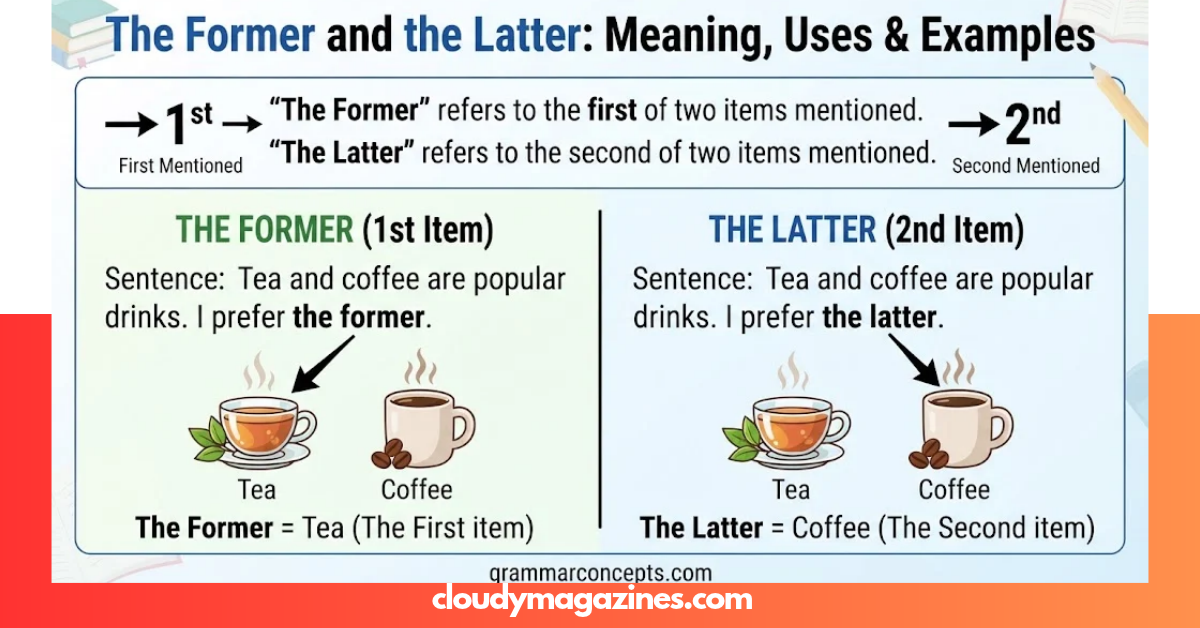
The former means the first of two things mentioned, while the latter means the second of two things mentioned. Cambridge Dictionary gives the same distinction: “the former” refers to the first of two people, things, or groups, while “the latter” refers to the second.
For example:
Tea and coffee are popular drinks. I prefer the former.
Here, the former means tea because tea appears first.
Tea and coffee are popular drinks. I prefer the latter.
Here, the latter means coffee because coffee appears second.
This simple first-versus-second rule makes the former and the latter easy to understand once you identify the order of the two items.
The Former vs. The Latter: Quick Difference
The easiest way to understand the former and the latter is to connect each word with its position.
| Word | Meaning | Position | Easy Memory Trick | Example |
| Former | First mentioned | First | Former → First | Sara and Ali arrived. The former was early. |
| Latter | Second mentioned | Second | Latter → Later | Sara and Ali arrived. The latter was early. |
| Former | Earlier or previous | Past | Former = previous | He is a former teacher. |
| Latter | Near the end | Later period | Latter = later | The latter part was difficult. |
When former and latter refer to two items in the same sentence or passage, their meaning depends on mention order, not on which item is more important.
What Does “The Former” Mean?
The former usually identifies the first of two people, things, choices, or groups that have already been mentioned.
Consider this example:
The company offered remote work and a higher salary. I chose the former.
The two options are:
- Remote work
- A higher salary
Because remote work appears first, the former means remote work.
Cambridge Dictionary also lists the former as a noun phrase meaning the first of two previously mentioned people, things, or groups.
Examples of “The Former”
- I can choose tea or coffee. I prefer the former.
- The store sells laptops and tablets. The former are more expensive.
- She studied biology and chemistry. The former interested her more.
- We discussed two plans. The former was easier to follow.
- Jack and Daniel joined the meeting. The former spoke first.
The key point is simple: the former always points to the first item when two items are being compared.
What Does “The Latter” Mean?
The latter normally identifies the second of two people, things, choices, or groups mentioned earlier.
For example:
You can take the bus or the train. I recommend the latter.
The order is:
- Bus
- Train
Therefore, the latter means the train.
Cambridge Dictionary defines the latter as the second of two people, things, or groups previously mentioned. It also uses latter to describe something near or toward the end of a period or sequence.
Examples of “The Latter”
- We can meet Monday or Tuesday. I prefer the latter.
- She bought a phone and a laptop. The latter was more expensive.
- The book has an introduction and a conclusion. The latter summarizes the main points.
- He considered walking and driving. He chose the latter.
- The course covers theory and practice. The latter includes several exercises.
A useful memory trick is to connect latter with later. The latter item is the one mentioned later.
How Do You Use “The Former and the Latter” Together?
You can use the former and the latter when referring to two previously mentioned items.
For example:
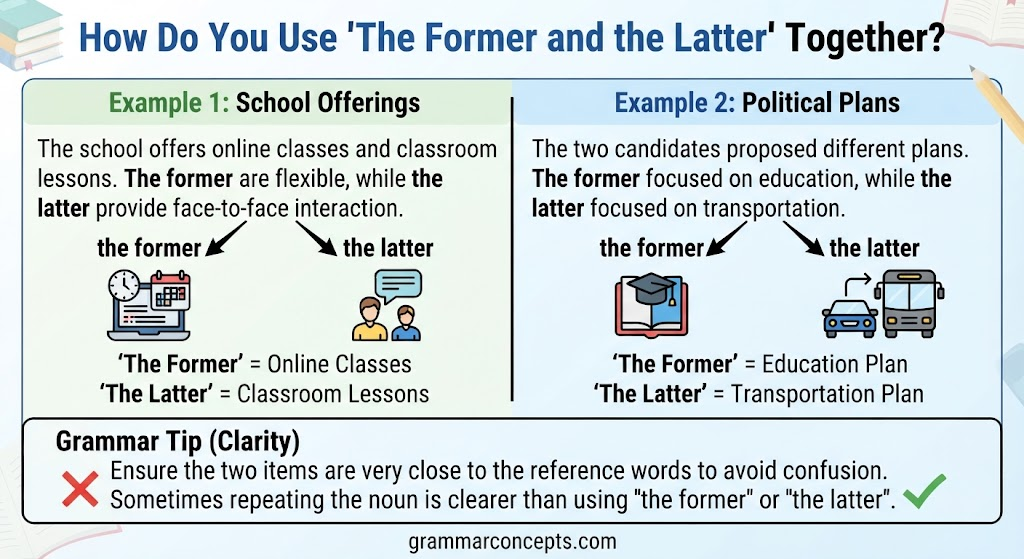
The school offers online classes and classroom lessons. The former are flexible, while the latter provide face-to-face interaction.
Here:
- The former = online classes
- The latter = classroom lessons
This structure works well because the reader can quickly identify both choices.
Another example:
The two candidates proposed different plans. The former focused on education, while the latter focused on transportation.
The first plan is the former, and the second plan is the latter.
The terms are especially common in formal, academic, business, and analytical writing. However, MLA Style Center warns that readers may need to look backward to identify what the words refer to, so repeating the original nouns can sometimes make a sentence clearer.
Can “Former” and “Latter” Be Used With More Than Two Things?
Generally, former and latter work best when you are referring to two items.
For example:
I like apples, oranges, and bananas. The latter is my favorite.
This sentence creates confusion because there are three items. Which item does the latter refer to?
For three or more items, it is usually clearer to name the specific item:
I like apples, oranges, and bananas. Bananas are my favorite.
This approach removes doubt and makes the sentence easier to read.
Dictionary.com also notes that former and latter traditionally identify the first and second items in a two-part sequence.
Former and Latter as Adjectives
Former and latter can also work as adjectives, but their meanings can change depending on the context.
For example:
She is a former employee.
Here, former does not mean “first of two.” It means she was an employee in the past but is not one now.
Cambridge Dictionary defines former as something or someone belonging to an earlier time or a past position. Examples include “former employer” and “former president.”
Similarly:
The latter part of the movie was exciting.
Here, latter means the part that comes later or nearer the end.
Cambridge identifies this meaning as “near or towards the end of something.”
Compare These Uses
| Sentence | Meaning of “former” or “latter” |
| I chose the former. | First of two choices |
| I chose the latter. | Second of two choices |
| He is a former manager. | Previous manager |
| The latter part was exciting. | Part near the end |
| She contacted her former employer. | Employer from the past |
| The latter stages were difficult. | Later stages |
Understanding the surrounding sentence is important because former does not always mean “first,” and latter does not always mean “second.”
What Is the Difference Between “Former” and “Previous”?
Former and previous can overlap, but they are not always interchangeable.
When former identifies one of two things, it establishes a contrast with the second item.
For example:
The company considered two locations. The former was cheaper.
Here, former means the first location.
But previous usually means something that came before another point in time or sequence:
The previous meeting lasted two hours.
The word previous does not necessarily create a two-item comparison.
Merriam-Webster’s thesaurus notes that former can imply a definite comparison or contrast with something that is later or “latter.”
Is “The Former and the Latter” Formal English?
Yes. The former and the latter are generally associated with formal or written English.
You may see them in:
- Academic essays
- Research papers
- Business reports
- Legal writing
- Formal correspondence
- News and analytical writing
- Educational material
They are less common in everyday conversation because speakers can simply repeat the noun.
For example, this is formal:
The company offered two packages. The former included support, while the latter included training.
A simpler version is:
The company offered two packages. The first included support, while the second included training.
Both are grammatically clear. The second version may be easier for a broad audience.
When Should You Avoid “The Former and the Latter”?
Avoid these expressions when they could make the reader stop and search through the previous sentence.
For example:
The manager discussed the employee with the supervisor before contacting the former.
Who is the former? The employee or the manager? The structure makes the reference unclear.
A clearer version would be:
The manager discussed the employee with the supervisor before contacting the employee.
The MLA Style Center specifically highlights this readability issue and recommends repeating the relevant terms when readers might have to reread a passage to understand the reference.
Avoid Them When:
- You mention more than two items.
- Several nouns appear close together.
- The reader could misunderstand the reference.
- The sentence is already complicated.
- Repeating the noun would improve clarity.
- You are writing for young or beginner English learners.
Clear writing is usually more useful than using a sophisticated-looking expression.
Common Mistakes With the Former and the Latter
Mistake 1: Reversing the Order
Incorrect:
Sarah and Emma attended the class. The latter refers to Sarah.
Correct:
Sarah and Emma attended the class. The latter refers to Emma.
The latter always points to the second item.
Mistake 2: Using Them for Three Items
Avoid:
I bought apples, bananas, and oranges. I chose the latter.
The reader cannot reliably determine which item you mean.
Instead:
I bought apples, bananas, and oranges. I chose oranges.
Mistake 3: Referring to a Distant Sentence
If the reader has to scan several paragraphs to find the two nouns, the former and the latter can reduce clarity.
Repeat the noun when necessary.
Mistake 4: Confusing “Former” With “First” in Every Context
In a sentence such as:
He is a former teacher.
Former means “previous,” not “first.”
Cambridge distinguishes this past-time meaning from the noun use of the former, which identifies the first of two previously mentioned items.
Mistake 5: Confusing “Latter” With “Last”
Latter can mean the second of two things, but it does not normally mean the final item in a list of many things.
For a long list, use last, final, or the specific noun when appropriate.
Easy Memory Trick for Former and Latter
A simple memory trick can make the difference stick:
Former = First
Both former and first begin with F.
Latter = Later
Both latter and later start with lat/later sounds and connect naturally to the idea of something mentioned afterward.
Example
I like tea and coffee. I prefer the former.
Think:
Tea = First = Former
Then:
I like tea and coffee. I prefer the latter.
Think:
Coffee = Later = Latter
This trick works especially well for English learners.
The Former and the Latter in Academic Writing
Academic writing often discusses two theories, methods, arguments, studies, or explanations. In those situations, the former and the latter can reduce repetition.
For example:
Researchers compared interviews and surveys. The former provided detailed responses, while the latter allowed researchers to collect more standardized data.
The terms make the relationship between the two methods clear.
Still, academic clarity matters more than avoiding repetition. If a sentence becomes difficult to follow, repeating interviews or surveys may be the better choice.
The Former and the Latter in Business Writing
Business writing can also use these expressions when discussing two options.
For example:
The company considered a monthly plan and an annual plan. The former offered greater flexibility, while the latter reduced the overall cost.
The structure clearly establishes:
- First option = monthly plan
- Second option = annual plan
For customer-facing content, however, simple wording may be easier:
The monthly plan offers flexibility, while the annual plan reduces the overall cost.
Choose the version that lets readers understand the message fastest.
The Former and the Latter in Everyday English
Although these words are correct, everyday English often uses first, second, or the actual noun instead.
Formal:
I offered him tea or coffee, and he chose the latter.
Simple:
I offered him tea or coffee, and he chose coffee.
Both sentences communicate the same basic idea.
If your audience includes children, beginner English learners, or readers who prefer plain language, repeating the noun can improve comprehension.
The Former and the Latter vs. First and Second
These expressions often perform a similar job, but they have different styles.
| Expression | Meaning | Style | Example |
| The former | First of two | Formal | The former was cheaper. |
| The latter | Second of two | Formal | The latter was faster. |
| The first | First item | Neutral | The first was cheaper. |
| The second | Second item | Neutral | The second was faster. |
| The first option | First choice | Clear | The first option was cheaper. |
| The second option | Second choice | Clear | The second option was faster. |
For most general web content, first and second can be easier for readers to process.
Examples of the Former and the Latter
Here are practical examples from different situations:
Food
I ordered pizza and pasta. The latter arrived first.
The latter = pasta.
Education
The student studied mathematics and history. The former was her favorite subject.
The former = mathematics.
Technology
You can use a laptop or tablet. The former is better for extended typing.
The former = laptop.
Travel
We considered Paris and Rome. The latter had a lower hotel price.
The latter = Rome.
Work
The company offered remote work or office work. The former provided more flexibility.
The former = remote work.
Shopping
I compared two phones. The former had a larger battery, while the latter had a better camera.
The former = first phone.
The latter = second phone.
A Simple Formula for Using Them Correctly
Use this three-step method:
Step 1: Find the Two Items
Look for the two people, things, choices, or groups mentioned.
Books and movies
Step 2: Check Their Order
The first item is:
Books
The second item is:
Movies
Step 3: Choose the Correct Word
- The former = books
- The latter = movies
So:
Books and movies both tell stories, but I prefer the latter.
The answer is movies because movies were mentioned second.
Quick Reference Table
| Question | Answer |
| What does the former mean? | The first of two previously mentioned items. |
| What does the latter mean? | The second of two previously mentioned items. |
| Does former always mean first? | No. It can also mean previous or belonging to the past. |
| Does latter always mean second? | No. It can also mean later or near the end. |
| Can you use them for three items? | It is usually clearer to avoid them and name the item. |
| Are they formal? | Yes, they are more common in formal written English. |
| What is an easy trick? | Former = first; latter = later. |
| Should web writers use them often? | Use them when the reference is immediately clear; otherwise repeat the noun. |
Frequently Asked Questions
What is the difference between “the former” and “the latter”?
The former means the first of two previously mentioned items. The latter means the second.
Example: “Tea and coffee are available. I prefer the latter.” Here, “the latter” means coffee.
What does “the former and the latter” mean in a sentence?
It means the writer is referring to two items already mentioned. The former identifies the first item, while the latter identifies the second.
Can “former” mean something other than first?
Yes. Former can describe something that existed or happened in the past.
Example: “She is a former teacher.” This means she was a teacher previously.
Can “latter” mean “near the end”?
Yes. Latter can describe something that happens later or near the end of a period.
Example: “The latter part of the movie was exciting.”
Can I use “the former” and “the latter” for three choices?
It is better to avoid them when three or more choices are involved. Name the specific item or use clearer terms such as the first, the second, or the last.
Are “the former” and “the latter” good for SEO content?
They can be useful when they make a comparison concise, but clarity should come first. For broad web audiences, directly naming the item can sometimes create a clearer and more natural reading experience.
Conclusion
The former and the latter are useful English expressions for referring to two previously mentioned things. The former means the first, while the latter means the second. Remembering former = first and latter = later makes the difference easy to recall.
Use these expressions when the reference is obvious and close to the two nouns. When a sentence becomes difficult to follow, repeat the original noun instead. Clear communication matters more than using formal vocabulary, especially when writing for a broad online audience.