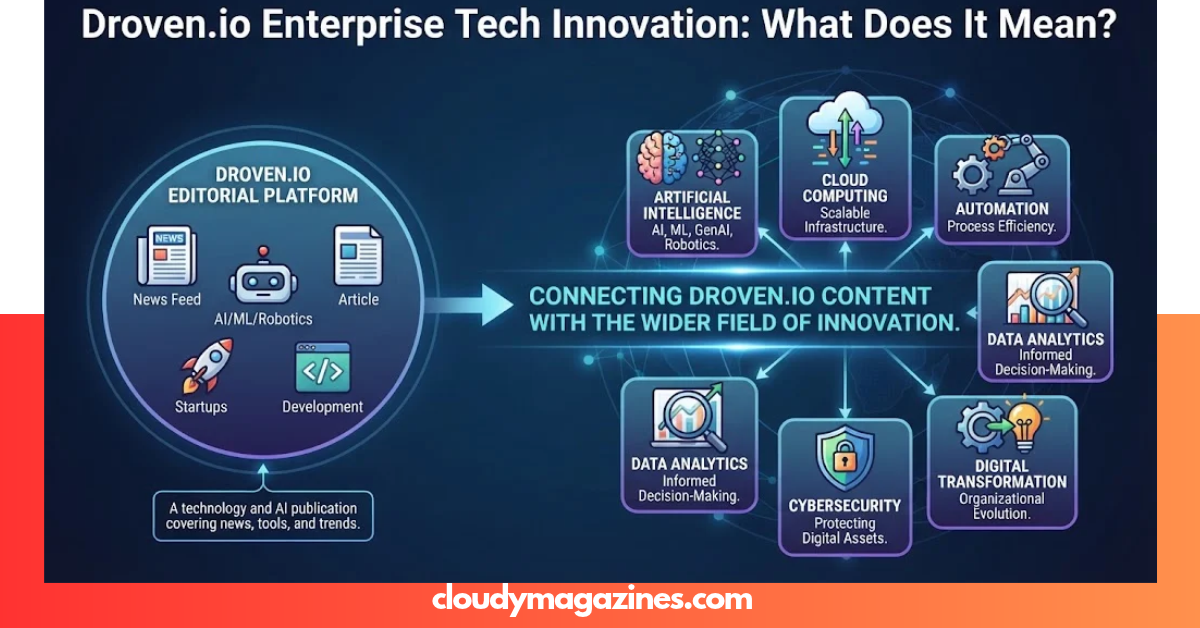
Droven.io enterprise tech innovation is best understood as a search topic connecting Droven.io’s technology coverage with the wider field of enterprise technology innovation.
Droven.io publicly describes itself as a technology and AI editorial platform covering areas such as AI news, AI tools, machine learning, generative AI, robotics, startups, development, and future technology. It does not present itself on its public homepage as a conventional enterprise software product with a documented SaaS subscription, enterprise dashboard, or deployable business platform.
The broader idea of enterprise tech innovation is much larger. It includes the practical use of artificial intelligence, cloud computing, automation, data analytics, cybersecurity, software development, and digital transformation to improve how organizations operate.
What Is Droven.io Enterprise Tech Innovation?
Droven.io enterprise tech innovation brings together two related ideas: Droven.io as a technology information platform and enterprise tech innovation as a business discipline.
Droven.io provides technology-focused information for readers who want to understand emerging tools, software trends, artificial intelligence, startups, and related subjects. Its public site lists eight broad categories, including AI News, AI Tools, Machine Learning, Generative AI, Robotics, Startups, Development, and Future Tech.
Enterprise tech innovation, meanwhile, describes the process of introducing technology into business operations to solve real problems. That can mean automating repetitive work, improving data analysis, moving systems to the cloud, strengthening cybersecurity, or introducing AI into customer and employee workflows.
The distinction matters because reading about enterprise technology is different from buying or deploying enterprise software.
In simple words
Think of the topic this way:
- Droven.io: A technology information and publishing platform.
- Enterprise tech innovation: The practical adoption of new technology by organizations.
- AI innovation: Using machine learning and generative AI to improve tasks and decisions.
- Cloud innovation: Using scalable cloud infrastructure and services.
- Automation: Reducing manual steps in repeatable workflows.
- Digital transformation: Modernizing processes, systems, data, and customer experiences.
Is Droven.io an Enterprise Software Product?
Based on its publicly visible website, Droven.io presents itself as an editorial technology platform, not as a traditional enterprise software vendor. Its homepage describes the site as a place for information about artificial intelligence, emerging technologies, innovative startups, and business strategies.
That means readers should not automatically assume that “Droven.io enterprise tech innovation” refers to a software package that companies can purchase and install.
| Question | Current public picture |
| Is Droven.io a technology website? | Yes |
| Does it publish AI content? | Yes |
| Does it cover emerging technology? | Yes |
| Does it discuss startups? | Yes |
| Does it cover software development? | Yes |
| Is it clearly presented as enterprise SaaS? | No |
| Is a public enterprise pricing model clearly shown? | Not on the public homepage |
| Is it useful for technology research? | Yes |
| Should buyers verify product claims elsewhere? | Yes |
This is an important trust point. A technology publication can help a business understand a category, but it should not be confused with the vendor that actually supplies the technology.
What Does Enterprise Tech Innovation Actually Mean?
Enterprise tech innovation means using technology to make important business activities more effective.
A company may start with a simple problem: employees spend too much time entering data manually. Instead of adding more people to the process, the organization might introduce workflow automation.
Another company may struggle to manage large amounts of customer information. It could use cloud databases, analytics, and machine learning to organize that information and identify useful patterns.
The technology changes, but the basic goal stays the same:
Find a business problem, apply suitable technology, measure the result, and improve the process.
That is the practical foundation behind enterprise innovation.
Why Is Droven.io Enterprise Tech Innovation Getting Attention?
Technology changes quickly, and businesses have more tools to evaluate than ever before.
Artificial intelligence, cloud platforms, automation software, cybersecurity systems, analytics platforms, and developer tools can all affect business operations. This creates a research problem: decision-makers need to understand what a technology does before deciding whether it deserves time or money.
This is where droven.io enterprise tech innovation becomes useful as a research topic.
Droven.io can help readers explore technology subjects in one place, while organizations can use primary documentation from technology vendors and standards bodies when they move from research to implementation.
Google also advises publishers to create original, helpful, reliable, people-first content rather than content made primarily to manipulate rankings.
What Technologies Fit Into Enterprise Innovation?
Enterprise technology innovation covers several connected areas.
1. Artificial Intelligence
AI can help organizations analyze information, classify documents, generate drafts, support customer service, detect patterns, and assist employees with knowledge-based tasks.
Generative AI adds capabilities such as text generation, summarization, coding assistance, image creation, and conversational interfaces.
However, organizations should evaluate accuracy, privacy, security, human oversight, and business value before putting AI into important workflows.
NIST’s AI Risk Management Framework provides voluntary guidance for organizations designing, developing, deploying, or using AI systems. It focuses on managing AI risks and supporting trustworthy AI practices.
2. Cloud Computing
Cloud technology allows companies to access computing resources, storage, databases, applications, and other services without maintaining every part of the infrastructure themselves.
Cloud adoption can support:
- Remote collaboration
- Scalable computing
- Centralized data
- Faster deployment
- Disaster recovery
- Application modernization
A strong cloud strategy still requires careful planning around security, cost, access control, data location, and system architecture.
3. Business Automation
Automation handles repeatable steps with software.
Common examples include:
- Moving information between systems
- Sending routine notifications
- Processing forms
- Creating reports
- Routing customer requests
- Updating records
- Scheduling repetitive tasks
The best automation projects usually begin with a clearly defined workflow instead of starting with a technology simply because it is popular.
4. Data Analytics
Data helps organizations understand what is happening inside the business.
Analytics can support:
- Sales forecasting
- Customer behavior analysis
- Inventory planning
- Financial reporting
- Marketing measurement
- Operational monitoring
Modern analytics often combines cloud data platforms, dashboards, machine learning, and business intelligence tools.
5. Cybersecurity
Innovation without security creates unnecessary risk.
Businesses need controls that protect accounts, applications, networks, devices, and sensitive information. CISA’s Cybersecurity Performance Goals provide voluntary, prioritized practices designed to help organizations reduce common cybersecurity risks.
Security should therefore become part of technology planning from the beginning rather than an afterthought.
6. Software Development
Modern software teams increasingly use cloud development environments, APIs, automated testing, version control, DevOps practices, and AI-assisted development.
These tools can shorten development cycles, but companies still need code review, testing, security checks, documentation, and experienced technical oversight.
How Does Enterprise Tech Innovation Work?
A successful innovation project does not need to begin with a large technology budget.
A simple process can work well:
Problem → Research → Pilot → Measure → Improve → Scale
Step 1: Identify the problem
Start with a measurable business problem.
For example:
Customer support employees spend four hours every day searching different systems for information.
That gives the technology team something specific to solve.
Step 2: Research possible solutions
Compare several approaches.
The company might consider:
- A knowledge base
- Search improvements
- Workflow automation
- An AI assistant
- Better system integration
At this stage, technology publications such as Droven.io can help explain unfamiliar concepts.
Step 3: Run a small pilot
Avoid changing the entire organization at once.
Test the solution with a small team or limited workflow first.
Step 4: Measure results
Useful measurements can include:
- Time saved
- Error reduction
- Cost per transaction
- Customer satisfaction
- Employee adoption
- Processing speed
- Security incidents
Step 5: Improve the system
A pilot may expose problems that were not visible during research.
Fix those problems before expanding the project.
Step 6: Scale carefully
Once the solution demonstrates value, the organization can expand it across additional teams or locations.
This approach makes enterprise innovation easier to manage and easier to measure.
What Can Businesses Learn From Droven.io?
Droven.io enterprise tech innovation can be useful for discovering and understanding technology subjects, particularly for readers who are still learning the difference between emerging technologies and actual business implementations.
Its public topic structure covers areas such as AI tools, machine learning, generative AI, robotics, startups, software development, and future technology.
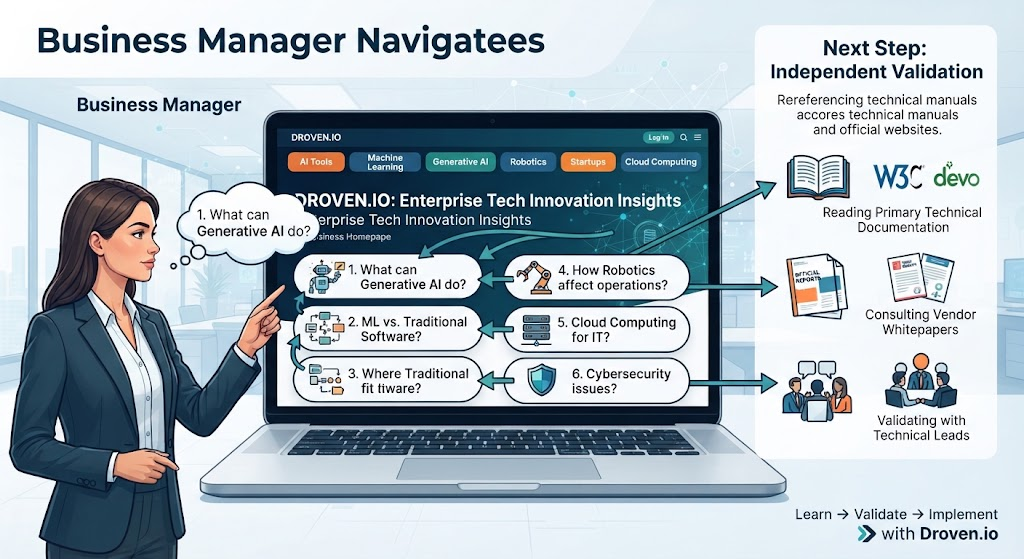
For example, a business manager could research:
- What generative AI can do.
- How machine learning differs from traditional software.
- Where automation fits into business processes.
- How robotics affects industrial operations.
- What cloud computing means for IT infrastructure.
- How software development is changing.
- What cybersecurity issues businesses need to consider.
The next step should be independent validation through primary technical documentation.
Droven.io vs Enterprise Technology Vendors
One of the easiest mistakes is treating every technology website as a technology vendor.
They serve different purposes.
| Area | Technology publication | Enterprise technology vendor |
| Main purpose | Explain technology | Sell or provide technology |
| Typical content | Guides and news | Product documentation |
| Pricing | Usually not central | Usually important |
| Product deployment | Usually not offered | Core function |
| Technical support | May be limited | Often available |
| Security documentation | May discuss it | Usually required for buyers |
| Product SLA | Usually not applicable | May be offered |
| Procurement | Not normally required | Often required |
| Best use | Research and education | Implementation |
This distinction makes droven.io enterprise tech innovation easier to understand.
Droven.io can be viewed as an information resource, while actual implementation requires a suitable vendor, internal technology team, consultants, or a combination of these.
How Should Companies Evaluate an AI Tool?
Before adopting an AI system, companies should ask practical questions.
Business fit
- What problem does the tool solve?
- Who will use it?
- How often will they use it?
- What measurable result should it produce?
Technical fit
- Does it integrate with current systems?
- Does it provide APIs?
- Can the organization export its data?
- Does it support required authentication methods?
Security
- Where does data go?
- How is information protected?
- Who can access it?
- What happens after an account is closed?
AI governance
Organizations should also consider accuracy, transparency, privacy, security, human oversight, and monitoring. NIST’s AI RMF organizes AI risk management around four functions: Govern, Map, Measure, and Manage.
Financial value
A technology purchase should have a clear reason.
A useful calculation is:
Technology value = measurable benefit − total cost
Total cost can include software fees, implementation, training, maintenance, integration, security work, and employee time.
What Are the Main Benefits of Enterprise Tech Innovation?
When properly planned, enterprise innovation can produce several practical benefits.
Faster workflows
Automation can remove repetitive manual steps.
Better decisions
Analytics can turn large datasets into information that managers can use.
Improved customer experiences
AI assistants, faster systems, and personalized services can reduce friction for customers.
Lower operational waste
Digital workflows can reduce unnecessary manual processing and duplicate work.
Easier scaling
Cloud infrastructure and modern software can help organizations expand without rebuilding every system from scratch.
Stronger visibility
Digital systems can make performance easier to track through dashboards and measurable metrics.
The key point is that technology itself does not guarantee these results. The outcome depends on implementation, workflow design, employee adoption, data quality, security, and ongoing measurement.
What Are the Risks?
Technology innovation also creates new risks.
Security risk
A poorly configured system can expose sensitive information.
Privacy risk
AI and analytics systems may process personal or confidential data.
Integration risk
A new application may not work properly with older business systems.
Cost risk
A low-cost subscription can become expensive when implementation and usage increase.
Adoption risk
Employees may avoid a system that is confusing or adds unnecessary work.
AI accuracy risk
AI-generated information can contain errors. Important outputs should receive appropriate human review.
NIST emphasizes that trustworthy AI requires attention to characteristics such as validity and reliability, safety, security and resilience, accountability, transparency, explainability, privacy, and fairness.
How Can a Small Business Use Enterprise Innovation Ideas?
Enterprise technology does not belong only to huge corporations.
A small company can apply the same principles on a smaller scale.
For example, a 10-person business could automate:
- Lead collection
- Appointment reminders
- Invoice notifications
- Customer emails
- Internal document search
- Basic reporting
- Social media workflows
- Customer support triage
The company does not need a massive digital transformation project.
It can choose one repetitive process, improve it, measure the result, and then decide whether another workflow deserves automation.
That approach reduces unnecessary spending and gives employees time to focus on work that requires judgment and creativity.
A Practical Enterprise Innovation Checklist
Use this checklist before adopting a new technology.
| Question | Why it matters |
| What problem are we solving? | Prevents technology-first decisions |
| Who owns the project? | Creates accountability |
| What data does it use? | Helps identify privacy and security needs |
| Does it integrate with current systems? | Reduces implementation problems |
| What will it cost? | Supports realistic budgeting |
| What result will we measure? | Shows whether the project works |
| What could go wrong? | Identifies operational risks |
| Is human review needed? | Protects important decisions |
| Can we scale it? | Supports future growth |
| Can we stop safely? | Reduces vendor and technology lock-in |
This simple framework can turn technology research into a practical business decision.
Is Droven.io Useful for Technology Research?
Yes, it can be useful as an informational starting point, especially when a reader wants to understand technology terms and emerging topics.
The public Droven.io website covers AI, machine learning, generative AI, robotics, startups, development, and future technology.
However, readers should separate education from verification.
If an article discusses an important technical claim, security feature, product specification, regulation, or business capability, verify it through the relevant primary source.
For AI governance, NIST is a useful primary source. For cybersecurity priorities, CISA provides official guidance. For Google Search guidance, Google’s own Search Central documentation should be used instead of third-party summaries.
This source-first approach makes research more reliable.
How Does Droven.io Enterprise Tech Innovation Relate to AI?
Droven.io enterprise tech innovation has a natural connection to AI because artificial intelligence is one of the major technology subjects featured on the platform.
The public site specifically lists AI News, AI Tools, Machine Learning, and Generative AI among its categories.
For businesses, AI can support several workflows:
- Document analysis
- Customer support
- Internal search
- Content drafting
- Software development
- Data classification
- Forecasting
- Knowledge management
The strongest business case usually comes from a specific workflow rather than a general desire to “use AI.”
What Does the Future of Enterprise Innovation Look Like?
Enterprise technology is becoming more connected.
AI increasingly works alongside cloud infrastructure, databases, automation platforms, cybersecurity systems, and business applications. Instead of treating every technology as a separate project, organizations are building connected digital workflows.
This shift creates a new priority for business leaders: integration.
A company may have excellent AI software but poor data. It may have modern cloud infrastructure but weak security. It may automate a process but fail to measure whether the automation actually improves performance.
The future of enterprise innovation therefore depends not only on adopting new tools, but also on connecting technology to clear business goals.
What Should You Verify Before Trusting Technology Information?
Before acting on a technology claim, check five things:
1. Source
Who published the information?
2. Evidence
Does the article provide documentation, data, testing, or direct references?
3. Date
Technology changes quickly, so older information may no longer apply.
4. Product status
Is the subject a real product, a concept, a category, or simply a phrase used in search results?
5. Primary documentation
Can the claim be confirmed through the company, government agency, standards organization, or original developer?
This process is especially important for AI, cybersecurity, privacy, and enterprise software.
Frequently Asked Questions
What is droven.io enterprise tech innovation?
Answer: It refers to the relationship between Droven.io’s technology-focused publishing and the wider field of enterprise technology innovation, including AI, automation, cloud computing, cybersecurity, analytics, and software development.
Is Droven.io an enterprise software company?
Answer: Public information currently presents Droven.io as an editorial technology platform rather than a conventional enterprise software product. Its website focuses on technology information and lists categories including AI, machine learning, robotics, startups, development, and future tech.
What topics does Droven.io cover?
Answer: Droven.io publicly lists AI News, AI Tools, Machine Learning, Generative AI, Robotics, Startups, Development, and Future Tech. It also highlights subjects such as OpenAI, Gemini, ChatGPT, automation, deep learning, neural networks, and AI ethics.
How can enterprise tech innovation help businesses?
Answer: It can help organizations automate repetitive work, analyze data, improve customer experiences, modernize infrastructure, strengthen security, and develop new digital services.
Should businesses trust technology information without verification?
Answer: No. Use technology publications for research, then verify important claims through primary vendor documentation, recognized standards bodies, and official sources.
How should a company start an innovation project?
Answer: Start with one measurable business problem. Research suitable technologies, run a limited pilot, measure the result, fix weaknesses, and expand only when the project demonstrates useful value.
Conclusion:
Droven.io enterprise tech innovation is best understood as a search topic connecting Droven.io’s technology publishing with the broader practice of using modern technology in business.
Droven.io publicly presents itself as an editorial platform covering artificial intelligence, emerging technology, software development, startups, robotics, and future tech. Enterprise innovation goes beyond reading about those subjects: it requires selecting the right technology, integrating it with existing systems, protecting business data, measuring outcomes, and improving workflows.