Adventure games have always been about exploration, discovery, and the quiet satisfaction of solving a problem through curiosity. A player wanders through a world, picks up a clue, notices something out of place, and puts the pieces together. That kind of experience used to demand a large team of programmers, artists, and writers working for years. No-code game makers are changing that by letting a single creator build the rooms, objects, and characters that make an adventure world feel alive, without first mastering the technical systems underneath. The result is a genre that’s becoming far more open to independent creators with a strong sense of place and story.
What Makes an Adventure Game Work
A good adventure game rests on a few dependable ideas. The player should always understand where they are and what they can interact with. Clues should reward attention, not luck. Progress should feel like the player’s own deduction rather than a checklist being completed for them. When those pieces line up, even a small world can feel rich and worth exploring.
Pacing matters just as much. Adventure games can easily become tedious when players are stuck with no direction, or when every puzzle takes too long to reset. Keeping each area focused, with a handful of interesting objects and a clear sense of what might be useful, keeps curiosity alive without overwhelming the player.
Ideas for Adventure Game Structures
A Single Location Explored in Depth
One of the simplest and most effective ideas is a single room or small area that reveals more with each visit. The player examines objects, combines items, and discovers that something they saw early on now has a new purpose. Because the space stays small, the creator can refine every interaction carefully, and the player can learn the environment well enough to feel clever.
A Chain of Connected Rooms
A series of rooms, each unlocked by solving something in the previous one, gives the adventure a sense of forward movement. A key found in the first room opens a door in the second. A symbol noticed in the third explains a lock in the fourth. This structure is easy to prototype with no-code tools, because each room can be built and tested on its own before being linked into the larger chain.
A Mystery Told Through Clues
Some adventures are built around a question rather than a place. Who took the artifact? What happened in the lighthouse? The player collects clues scattered across locations, and the satisfaction comes from assembling the answer. Creators can prototype the clue system first, then fill in the locations once the logic feels right.
A Journey Through Changing Environments
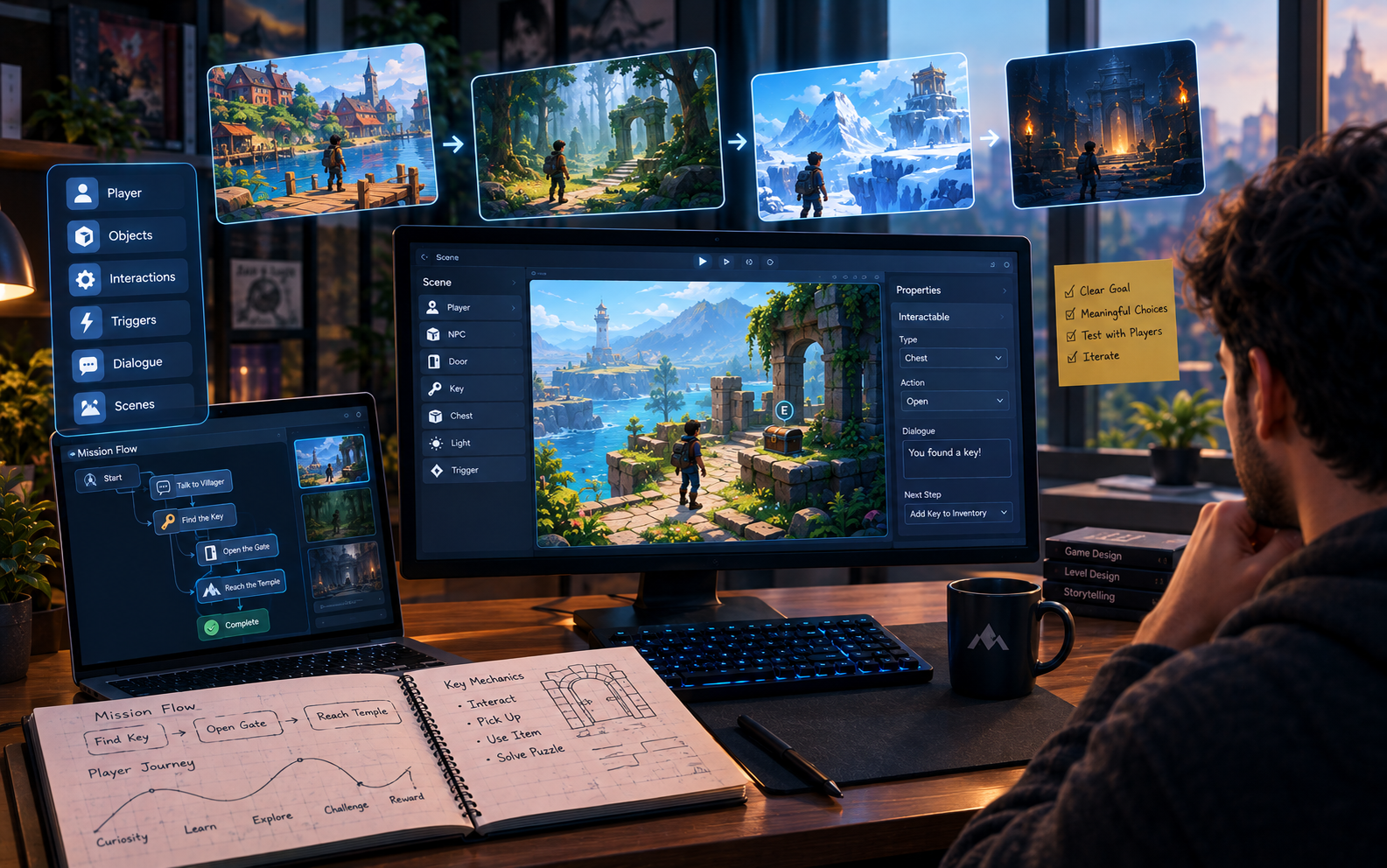
Adventure games don’t have to stay in one kind of setting. A journey that moves from a village to a forest to a ruined temple gives each area its own mood and puzzle style. Testing each environment separately lets creators tune the feel of every stage before tying them together.
Using No-Code Tools to Build Adventure Content
Placing Objects and Characters Quickly
Traditional adventure development required setting up every interaction in code. No-code tools let creators place objects, characters, and triggers visually, then define what happens when the player interacts with them. That shift turns room design into something closer to arranging a stage, which makes it far easier to experiment with layouts and clue placement.
Testing Puzzles Without Rebuilding
Puzzles are the most fragile part of any adventure game. A puzzle that seems clever on paper often turns out to be confusing or too easy in practice. No-code tools let creators change a clue’s position or wording and replay the puzzle immediately. Dozens of small adjustments can happen in the time it would have taken to fix a single line of traditional code.
Writing Dialogue Alongside Design
Because dialogue and interactions live in the same tool, writers can refine conversations while testing how they fit into a puzzle. A character who hints at a solution needs to sound natural and say just enough. Seeing that dialogue play out in context reveals whether the hint is too obvious, too vague, or just right.
Testing Adventure Games With Real Players
Watch How Players Look for Clues
Give a player a new room and say nothing. Watch where their attention goes. Do they examine the objects you hoped they would notice? Do they miss a clue that felt obvious to you? Those moments show whether your environment communicates what matters, and where it’s getting lost.
Notice When Players Get Stuck
Being stuck is part of adventure games, but being stuck with no sense of what to try next is a problem. If players repeatedly circle the same area without making progress, the next step is probably hidden too well or depends on a clue that never appeared clearly enough.
Check Whether Solutions Feel Earned
After a player solves a puzzle, ask them how they got there. If they describe a moment of connection, the puzzle worked. If they say they guessed, the clue needs to be more meaningful, or the solution needs a stronger link to what came before.
A Practical Example of Adventure Design
Astro Guys shows how a story-driven game can build its identity around characters and atmosphere. Its focus on personality and tone gives players a reason to explore and engage with what they find, which is at the heart of the adventure genre.
Creators who want to build adventure games can start with a game builder that supports fast room-by-room prototyping, so puzzles and clues can be tested with real players before the full world takes shape.
Common Adventure Game Mistakes
The most common mistake is hiding clues so well that players never find them, or placing them so obviously that solving the puzzle feels like reading a manual. Another is building a world too large before the core puzzles have been tested. A third is letting dialogue explain every answer, which removes the satisfaction of figuring things out. Playtesting catches all three early, while changes are still quick to make.
Final Thoughts
No-code game makers open the adventure genre to creators who have a strong sense of place and story but limited programming time. Start with a structure that fits your idea, whether that’s a single rich room, a chain of connected spaces, a clue-driven mystery, or a journey through changing environments. Use visual tools to place objects and test puzzles quickly, and keep dialogue tied to the moments it supports. Then watch real players search, get stuck, and solve. When they feel clever rather than guided, the adventure is working.