
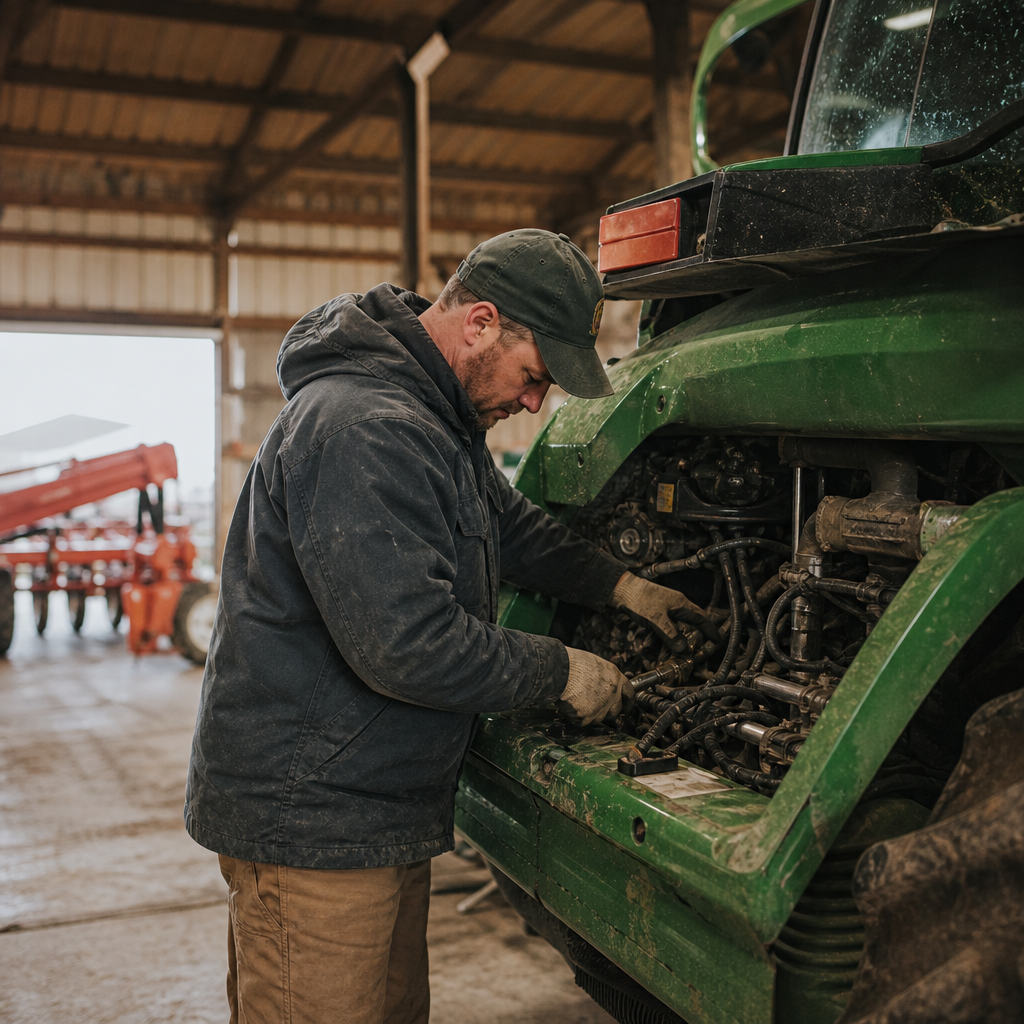
Most compact tractors do not die in the field. They die in the shed, slowly, between November and March, while nobody is looking. Fuel goes stale, condensation collects in a half-empty tank, a battery sulfates, mice move into a wiring harness, and the grease that was supposed to be protecting a loader pin dried out two seasons ago. Then in April the owner turns the key, hears a click, and decides the machine is unreliable.
The fix is unglamorous and takes about an afternoon. What follows is the order of operations experienced operators and service techs actually use when putting a 25- to 60-horsepower tractor, a finish or rotary mower, and a round baler away for the cold months — plus the few places where it genuinely pays to stop doing it yourself.
Step one: wash it, then look at it
Pressure-wash the machine and let it dry completely before it goes under cover. Caked mud holds moisture against sheet metal and traps chaff near exhaust components; dried hay and leaf litter in an engine compartment is both a fire risk and a nesting invitation. Blow out the radiator and oil cooler fins from the fan side, pull the hood screens, and clear the area around the muffler and turbo if the tractor has one.
The wash is also your inspection. With the dirt gone you can see seep at a hydraulic fitting, a hairline crack in a loader bracket, a chewed boot on a tie rod, or a 3-point lift arm pin that has worn oval. Write those down. A parts list made in November gets filled calmly; the same list made the first warm Saturday in spring gets filled in a panic.
Fluids and fuel: the two mistakes that cost the most
Change the oil before storage, not after
Used engine oil carries acids and combustion byproducts. Leaving it in a block for five idle months is exactly the wrong move, even though it feels thrifty to wait until spring when the hours will start climbing again. Change engine oil and filter at shutdown, then run the engine a few minutes so clean oil coats everything. Check hydraulic and transmission fluid levels and the condition of the hydraulic filter; if your service interval lands anywhere near the current hour reading, do it now.
Diesel wants a full tank and a plan
Fill the tank. Air space is where condensation forms, and water in diesel feeds microbial growth and plugs filters. Add a storage-grade stabilizer and, if the machine may be used on cold days, a treatment that addresses cold-flow and gelling. Drain the water separator. Replace the fuel filter if it is mid-life — a filter is cheap compared to purging a fuel system in February. Gas-powered mowers and generators are a different animal: ethanol-blended fuel is the usual culprit behind gummed carburetors, so either stabilize a full tank or run the unit completely dry.
Coolant deserves a test strip rather than a glance. Color tells you nothing about freeze protection or additive depletion. If the mix is weak, flush and refill to specification; a cracked block from a weak coolant mix is the single most expensive way to learn this lesson.
Batteries, grease and rubber
- Clean the battery terminals, coat them, and put the battery on a quality maintenance charger rather than a trickle charger left unattended. A battery stored at partial charge in the cold loses capacity permanently.
- Grease every zerk — loader pins, 3-point, driveline slip joints, PTO shaft u-joints, wheel bearings on mower decks and rakes. Fresh grease pushes moisture out.
- Inflate tires to spec and, if you can, get the machine off soft ground. Tires parked in mud for a winter develop flat spots and bead corrosion.
- Retract hydraulic cylinders where possible so exposed chrome rod is minimized, and wipe rods with a light oil.
- Loosen belt tension on mowers and balers, or at least note which belts are glazed and crack-faced so you can order replacements over the winter.
Hay equipment earns its own checklist
Balers, mower-conditioners and rakes come out of the season full of crop residue, and residue plus humidity equals rust on belts, rollers and pickup teeth. Strip the chambers, sweep the belt surfaces, inspect every pickup tooth and tine for bend or breakage, and check chain tension and sprocket wear while the memory of the last bale is fresh. On a disc mower or cutterbar, pull the module oil sample — milky fluid means a seal is already going, and that is a winter project, not a hay-season emergency. Sickle sections and guards, baler belt lacing, and pickup bearings are all parts you want on the shelf before the first cutting.
If you want a second opinion on intervals and procedures beyond your operator’s manual, the Purdue Extension guidance on farm machinery care and storage is a sensible cross-check, particularly on why off-season protection of bearings, belts and painted surfaces matters more than most owners assume. Read it alongside your manual rather than instead of it — manufacturer specifications always win on fluid types, capacities and torque values.
When to hand it to a parts counter and a service bay
Filters, seals, belts and gaskets are where fit tolerances matter most, and where a generic substitute quietly changes a machine’s behavior — a filter with the wrong bypass pressure or media rating does not announce itself until something expensive wears out. That is the argument for genuine parts on wear items and for letting a technician handle emissions-system work, regeneration faults, hydraulic diagnostics and anything under warranty. Dealerships like H&R Agri Power sit on both sides of that line: they sell new and used tractors, implements and pre-built or custom Kubota tractor packages, and they also run parts counters and repair shops at their Kentucky, Tennessee and Indiana locations, including lawn mower repair in Owensboro. Their own write-up on how to winterize Kubota equipment is a good model for turning a vague intention into a checklist you can actually work through, and it is a reasonable starting point for a conversation at the parts window about which genuine Kubota components your particular model and hour reading need.
Store it dry, label it, walk away
Indoors on gravel or concrete is ideal. If the machine lives outside, cover the stack and air intake, leave the rest breathable, and avoid wrapping a tarp tight enough to trap condensation. Block mouse entry at the cab, the air cleaner and the toolbox. Then tape a note to the steering wheel listing what you did and what still needs doing. Future you will not remember whether the hydraulic filter got changed.
There is a quiet payoff to doing this properly, and it is not only mechanical. The shutdown ritual is the one week of the year when the equipment is not demanding anything from you, which is why so many acreage owners treat the last pass of the season like a small holiday — clean the machine, close the shed, and go eat something you did not cook, whether that is barbecue or a plate of sonso de yuca from a place worth driving to. The work will be there in March. The point of winterizing is that it will be work you chose, not work a dead battery chose for you.
A two-hour version, if that is all you have
- Blow off chaff, especially around the exhaust and radiator.
- Fill the diesel tank and add stabilizer; drain the water separator.
- Test coolant freeze protection and correct it.
- Change engine oil and filter, then run the engine briefly.
- Grease every fitting, including PTO shafts.
- Pull the battery onto a maintenance charger.
- Set tire pressures and park on a hard, dry surface.
- Write the spring parts list while you still remember the noise it was making.
Do those eight things and the vast majority of cold-weather failures never happen. Skip them and the tractor will tell you about it, loudly, on the first day you need it.